Showing posts with label wildfire. Show all posts

Thursday, August 7, 2025

The False Narrative About Defending Freedom and Democracy

Full disclosure: The following is the distillation and final conclusion of an investigation I launched using Perplexity AI (Link to complete AI exchange). 

Many people in the US and other Western countries believe their governments serve to promote freedom and democracy worldwide. However, this is often a false narrative—part of a deceptive conspiracy to mask less laudable priorities. theconversation.

When such conspiracies cease to be persuasive, they have to be refreshed. 
 

While official statements emphasize defending human rights, democracy, and freedom, the reality is more complicated and often contradictory:

  • Military and Covert Coercion: Democratically elected leaders have been overthrown or even assassinated with Western involvement when their policies threatened Western economic or geopolitical interests:
    • The 1953 US CIA coup in Iran ousted Prime Minister Mohammad Mossadegh after he nationalized oil, replacing him with the autocratic Shah britannica.
    • The 1973 US-backed coup in Chile toppled President Salvador Allende, leading to Augusto Pinochet’s dictatorship bbcnews.
    • Similar covert interventions occurred in Guatemala (1954) history.com, and the Dominican Republic, among others guardian.
  • Economic Coercion: Western-dominated institutions—such as the International Monetary Fund (IMF) and World Bank—often impose policies that benefit Western corporations and markets at the expense of local sovereignty and democratic choice in less developed countries eurasiareview. US-led sanctions and trade pressures are also used to achieve political goals carnegie.
  • Political Manipulation and Election Interference: The US and its allies have covertly funded political actors, manipulated media narratives, and interfered in elections abroad to promote governments favorable to Western interests, undermining democratic processes foreignpolicy.
  • Hypocrisy in Promoting Democracy: While Western governments publicly claim to defend democracy and rights, they often support authoritarian regimes when it suits their strategic interests carnegie lowy.

These practices mean the official narrative about protecting freedom is intertwined with coercion, manipulation, and selective enforcement—a coordinated strategy that misleads citizens about the real intent of foreign policy theconversation.

Evolution of the "Rules-Based World Order"

After World War II, the US and Western powers built a system led by institutions like the World Bank, IMF, WTO, G7, and NATO. This system promised universal benefits but was structured to favor Western interests eurasiareview carnegie.

  • The rules and their enforcement have been selective, protecting Western allies and constraining less powerful states lowy.
  • Developing countries have often faced economic pressure that benefits Western corporations and limits their sovereignty.
  • NATO and similar alliances have functioned primarily to ensure Western strategic dominance.

The Shift to Transactional Bilateral Diplomacy (Since 2025)


With President Trump’s return in 2025, US foreign policy shifted away from multilateral alliances to bilateral, transactional deals focused on short-term gain and hard leverage carnegie25 diplomacyedu.

  • Traditional allies, such as Canada and Japan, heavily reliant on US markets and with less diversification, became especially vulnerable "lowest hanging fruit" to pressure and demands brookings.
  • This shift increased unpredictability and forced allies to diversify relationships to reduce dependence chathamhouse.
  • Authoritarian regimes face less US pushback and are increasingly assertive foreignpolicy2025.
  • The US focus is now on economic nationalism and deal-making, sidelining democracy and rights.

Impact on Global Power and the Emerging Multipolar World

  • The weakening of the Western-led order and US retreat from multilateralism is creating space for other powers, like China and India lowy.
  • Many countries seek a more multipolar world with diversified economic and security ties carnegie.
  • Old allies economically overexposed to the US are now less secure, while stronger or more diversified middle and rising powers have increased leverage nytimes2025.

Plain Language Summary

In short: The widely believed story that the US and its allies are mainly motivated by promoting freedom and democracy worldwide is largely a myth, crafted to hide real priorities of protecting markets, resources, and global power theconversation.

For decades, Western powers have undermined democracy—including with coups, covert interventions, and economic pressure—when it conflicted with their interests. The so-called rules-based order promised fairness but delivered disproportionate benefits to the West. Now, under "America First" transactional diplomacy, even long-standing allies are under economic and political pressure, while the US abandons its previous commitment to collective values.

This shift is fueling the emergence of a multipolar world—where power is spread among more nations, alliances are uncertain, and those who once called themselves defenders of democracy now often challenge those very ideals in practice.

Wednesday, August 6, 2025

Can the Wildfire Genie be Put Back in the Lamp?

This year (2023) the number and intensity of wildfires in Canada reached unprecedented levels. The previous record, set in 2014, was almost tripled. Furthermore, this year's fires have emitted almost three times as much greenhouse gasses as have all other sources. In a year like this one, even if we had managed to completely eliminate all of our fossil emissions, two thirds of our total emissions would still remain.  No number of electric vehicles, solar panels, windmills, nuclear plants, or carbon-capture technologies would bring us anywhere near our emission reduction targets. Can the wildfire genie be put back into its bottle?


Perhaps all is not yet lost. Perhaps this year was a one-off. Perhaps climate change has nothing or little to do with the number, intensity, and frequency of 2023's GHG emitting wildfires. On the other hand, perhaps hotter temperatures for longer periods of time are drying out our forests and turning carbon sinks into tinder boxes, often ignited by a lightning strike or careless humans. Perhaps this years emissions will join all the other GHG already up there (Its been accumulating for centuries), creating even hotter conditions for even longer periods of time with greater frequency than ever, in what is called a positive feedback loop. What does the science say? Below is a graph of Canada's wildfire emissions in recent years:

This is an absolutely staggering increase in emissions. Especially  at a time when we are trying, so far unsuccessfully, to reduce our fossil fuel emissions, as if those were our only problem. And our fossil fuel emissions must absolutely be reduced, but let's stop pretending they are the only source of Canada's GHG emissions. 

To be sure, it may seem unfair to Canadians to have to accept responsibility for emissions resulting from an increase in wildfires which result from global pollution--pollution they think that Canada is doing relatively little to contribute to, compared to, say China. But nature makes no distinction between fair and unfair emissions. She readily accepts and processes and absorbs them all. And in the process nature herself is altered. We are already witnessing this.

Whether or not 2024's wildfires will be as bad as 2023, I'm guessing probably not. I'm hoping for a period of grace. But I do believe that we will continue to break records: heat records, rainfall records, hurricane and tornado records, drought records and yes, sooner or later wildfire emission records. 


Thursday, June 19, 2025

The Ring of Fire: A Climate Genie We Can’t Put Back

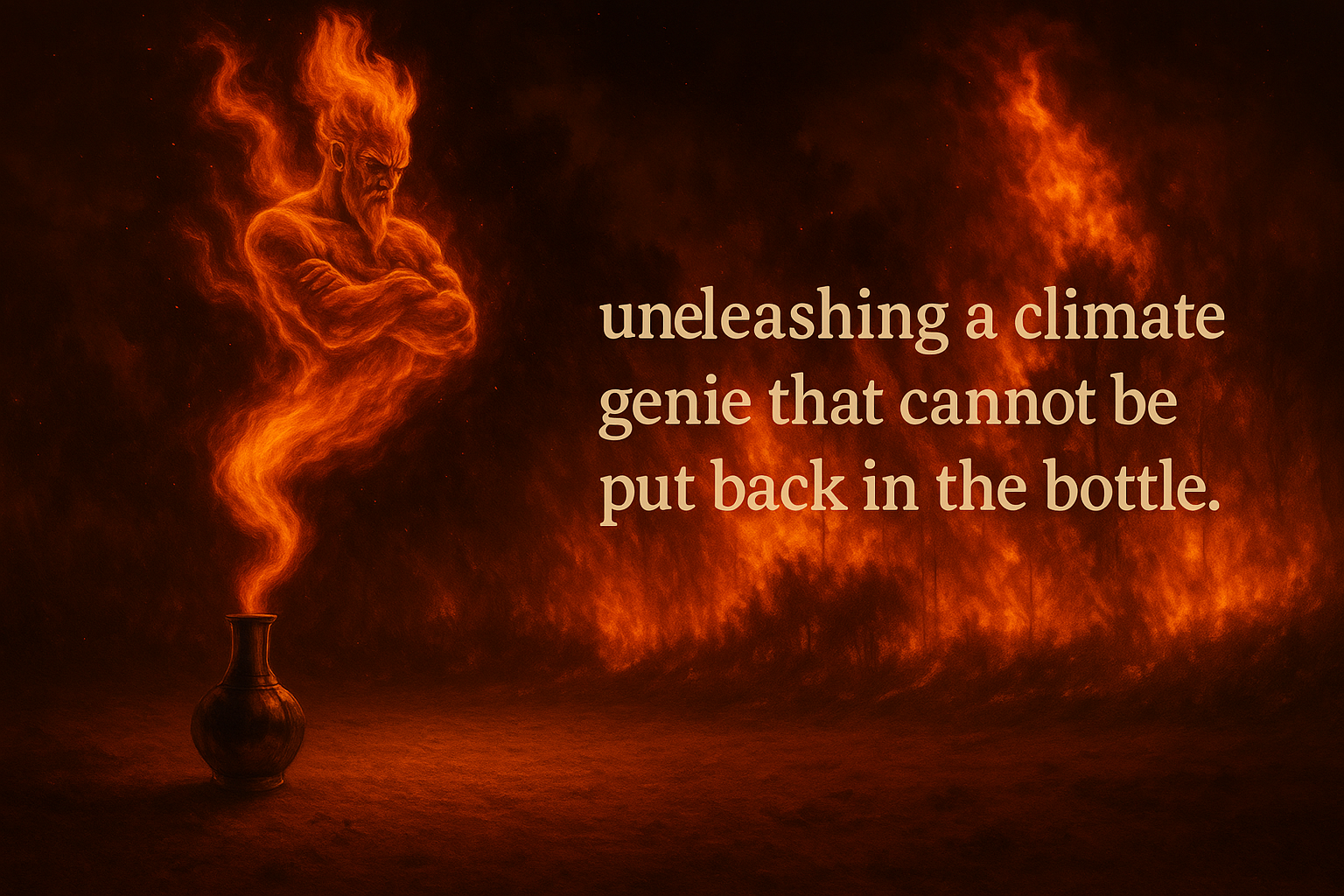
Fiery genie with wildfire background and text to the right

Canada’s rush to mine critical minerals in Ontario’s Ring of Fire threatens to unleash a climate risk far greater than its promised benefits for the green energy transition. The region’s vast, ancient peatlands store up to 35 billion tonnes of carbon—making them one of the world’s largest and most stable carbon sinks. Mining and road-building would lower the water table, dry out the peat, and trigger the release of massive, irreversible carbon emissions—potentially hundreds of millions of tonnes of CO₂ and methane.

Once dried, these peatlands become highly vulnerable to catastrophic fires. Peat fires are notoriously difficult to extinguish, often smoldering underground for months or even years, releasing enormous amounts of carbon and making restoration virtually impossible. Despite this, wildfire emissions—which now far exceed Canada’s official, human-caused emissions—are not counted in climate targets or public debate. There are no national or global wildfire emission-reduction targets, leaving a dangerous gap in climate policy as we approach an irreversible feedback loop: more fires, more emissions, more warming.

The minerals beneath the Ring of Fire are important for electric vehicles and renewable energy, but the carbon cost of disturbing these peatlands could negate any climate gains. The risks—climate, ecological, and social—dwarf the economic benefits.

We are on the verge of unleashing a climate genie that cannot be put back in the bottle. The world must recognize and protect the irreplaceable carbon sinks of the North before it’s too late.


Thursday, September 21, 2023

Climate Change: The Tragedy of the Commons

 --by Stewart Vriesinga

Many of us have at least heard of the Tragedy of the Commons, likely as not from an all but forgotten economics class in our youth. Rightly or wrongly I thought the lesson was to show why communal property was likely to be decimated by users over-use of common resources. The example used was un-owned pastures on which the beneficiaries, acting in their own self-interest, put their livestock out to graze. Without ownership there was no oversight as to how many sheep or cattle could be pastured there, and consequently the pasture was trampled and grazed out of existence.  The land remained, but the pasture didn’t. 


Today we still have “the commons”; communal pastures may be pretty scarce these days, but our oceans, the air we breath, and the stratosphere and climate we all share are the “commons” today. They are not the private property of any individual, government, corporation, or any other entity. I thought I should revisit the lesson of The tragedy of the Commons. Full disclosure: I enlisted the help of Perplexity AI. Here is what it came up with:


Q:  Please explain "The Tragedy of the Commons".

A    (Perplexity AI):


The Tragedy of the Commons is an economic and environmental science problem where individuals have access to a shared resource and act in their own interest, at the expense of other individuals 6.This can result in overconsumption, underinvestment, and depletion of resources 5. The concept was first presented in an essay written in 1833 by British economist William Forster Lloyd, and later popularized in a 1968 article by Garrett Hardin 5.The tragedy of the commons occurs when a resource is rivalrous in consumption, non-excludable, scarce, and a common-pool resource 2. In other words, it occurs when individuals with access to a public resource act in their own interest and, in doing so, ultimately deplete the resource 1

The tragedy of the commons highlights the conflict between individual and collective rationality 5. Individuals tend to make decisions based on their personal needs, regardless of the negative impact it may have on others 1. In some cases, an individual’s belief that others won’t act in the best interest of the group can lead them to justify selfish behavior 1. To prevent the tragedy of the commons, there should be some restrictions to the amount of usage, for example, property rights must be affixed 6. Exercising restraint would yield benefits for all in the long-term, as the shared resource would remain available 6.

(The numbers are clickable links to the AI's sources)

"...it occurs when individuals [or countries, or corporations] with access to a public resource act in their own interest and, in doing so, ultimately deplete the resource." Deplete what? Our soil? Our oceans? The stratosphere? All of the above? That does indeed sound tragic! 

The thing is, there are things we can do to mitigate the damage. We know what they are. There are also reasons those things aren't being done. The problem is political. The problem is that everyone--I mean everyone, rich or poor, wants a "just transition". What constitutes a just transition depends on who you ask and on where they fit into the global scheme of things. Poor countries which have done nothing to cause climate change want compensation for damages caused by climate change--wildfires, droughts, floods, hurricanes, etc.  --a polluter-pay proposition;  Low-lying and island countries want assurances that they won't be submerged by rising sea levels; Oil workers want new green jobs of equal pay in the new green economy. (Anything less than that would not be construed as a just transition); oil producing countries want to keep producing oil;  etc . It is not surprising that after 27 COP summits the inter-governmental panel on climate change (IPCC) is unable to come to a consensus. The United Nations, under whose auspices ICPP falls, is the closest thing we have to a world government, and has been sounding the alarm ever more shrilly with increasing frequency, but to no avail. CO2 emissions continue to rise. 

Given the general consensus on the part of COP participants that climate change represents a major threat to all life forms on the planet, one might assume that arriving at a consensus on what to do about it should not be that difficult. Not so. The decision-makers, most of them elected, must take into account how their constituents will respond to whatever they agree to at a COP summit. As such they are unlikely to commit to anything that would hinder their prospects in the next election. For example, here in Canada asking constituents to hand over the keys to their internal combustion vehicles, or to stop flying, is a non-starter. Not even the Green Party would go there. In the case of the former the way of life of most Canadians remains reliant on internal combustion vehicles. In the case of the latter, the tourism industry and airlines, not to mention much of the general public, would find such commitments totally unacceptable. What would be acceptable? Enter net zero emissions. 

The genius of net zero targets, usually set for some time well after the next election, is that it allows oil-exporting countries to keep right on exporting oil while still meeting their targets. This is achieved by passing responsibility for emissions from exported fossil fuels on to the end consumer countries. The only emissions oil-exporting countries are responsible for are those that occur on the exporters' own soil. These can be off-set through the acquisition of carbon credits--protected forests, wetlands, carbon capture technology, a reduction in local emissions, etc. This policy was agreed upon, so oil-producing countries are under no obligation to stop extracting and exporting fossil fuels. This may do little to protect the commons--to reduce global emissions, but allows exporting countries to keep right on extracting and exporting. These net zero targets also go a long way toward mollifying increasingly alarmed constituents who are living and/or witnessing the ravages of climate change. Similarly the construction of electric vehicle and battery plants holds out the hope that car-owners can continue to drive uninterrupted, while simultaneously protecting the environment. 

Another way of meeting emission targets is by excluding CO2 emissions from the total. This year--2023--the emissions from Canada's wildfires was more than twice the amount resulting from the burning of fossil fuels. Our carbon sinks are turning into carbon sources. The decision to exclude these emissions from the total makes some sense because the increase in frequency, duration, intensity and devastation caused by wildfires cannot be attributed to Canada's emissions alone. Nevertheless they are part of the global total, and as such will not be without consequences. 

Whether or not a consensus on the part of all COP participants is necessary is somewhat debatable. While all countries are suffering the consequences of climate change, only a few of them are responsible for the lion's share of emissions. Once again I will enlist the help of Perplexity AI to make my point. (For those of you who are skeptical about the reliability of the AI answers, I encourage you to click on the AI sources--the numbers--and to do your own independent research.) Here is what Perplexity came up with:

Q:  How many countries are responsible for the lion's share of GHG emissions? Which countries are the least responsible?

A    (Perplexity AI):

According to the search results, a few countries are responsible for the lion's share of GHG emissions. The US and EU have caused the most GHG emissions historically, with a combined total of 37% cumulative emissions globally 2 China, the US, the European Union, India, the Russian Federation, and Japan were the top carbon dioxide (CO2) emitters in 2014 5 However, when looking at historical emissions per capita, the US and Russia have the highest per capita emissions, while India's per capita emissions are the lowest 2.  

On the other hand, many of the world's poorest countries are the least polluting but the most climate-vulnerable 3 The 46 least developed countries (LDCs) were estimated to account for about 1.1% of total world CO2 emissions from fossil-fuel combustion and industrial processes in 2019 6 Even in per capita terms, LDCs' CO2 emissions barely reach 9% of the world's average 6.

It seems that an agreement among those few worst polluting countries would go a long way toward engendering an appropriate response to the problem. But that is not going to happen until they are more focused on protecting the environment than they are on protecting their respective economies. There is also the matter of how influential oil industry lobbyists are at these COP summits; they far outnumber many governmental delegations. 

So the question remains: Can we prevent the tragedy of our commons--our water, land, and stratosphere--from occurring? Or will what remains of the ecosphere go the way of the dodo bird? The answer is entirely contingent on whether or not the decision-makers stop pursuing their own national, corporate, or individual self-interest, thereby destroying the hand that feeds us; or instead seek and implement solutions that will respect and safeguard all of humanity along with the other lifeforms with which we share this planet.  Undoubtedly the planet will survive, but without radical change in priorities on the part of the decision-makers, most life-forms, including humans, will not survive this current tragedy of the commons.

Sunday, August 6, 2023

Past the Tipping Point:

Here in Canada we are now past the tipping point. Even if we eliminate emissions from all other sources, wildfires alone put us well over our emission targets. A positive feedback loop in which this year's emissions get added to the accumulated emissions from previous years/decades/centuries, ensure that next year's temperatures will be even higher, drying out even more forests and tundra, melting even more permafrost, turning it all into kindling for next year's fires, thereby ensuring that they will be more numerous and ferocious than this year's fires. And so on.

None of this will be immediately apparent to most people because powerful interests don't want it to be. We are constantly being fed a steady diet of claptrap to bamboozle us and to lull us into an unwarranted sense of complacency. First and foremost, emissions from wildfires are not included in the tally of Canada's emissions because they are considered carbon neutral--the vegetation will grow back and reabsorb any GHG emissions released by a fire; and secondly, because wildfires are not considered to be anthropomorphic (caused by humans). But discounting them does not make these emissions go away, just as exporting fossil fuels doesn't mean that they don't get burnt elsewhere and contribute to global warming. A realistic prognosis for the planet must include all GHG emissions, whether someone accepts responsibility for them or not. GHG emissions are a global problem, and as such national solutions are limited.

Some wildfires are not anthropomorphic. Wildfires predate the industrial revolution and the burning of fossil fuels. But the increased intensity, frequency, size and number of wildfires is indeed anthropomorphic--exacerbated by global warming. The importance of this cannot be exaggerated; the emissions from wildfires in Canada have now eclipsed emissions from all other sources. Our once enviable carbon sinks have become liabilities--primary sources of GHG emissions. Discounting and excluding wildfire emissions from the total tally gives a very deceptive and dangerously misleading indication of where we're really at. 


We hear a great deal about emission reduction plans: Solar energy, wind energy, new nuclear plants, car battery plants for EVs, carbon capture technologies, etc. Despite all these, even excluding wildfire emissions and exported fossil fuels from the mix, our total GHG emissions have continued to rise. Nothing that has been done to date has lowered our GHG emissions. On the contrary. Adding wildfire emissions to the mix more than doubles Canada's total emissions. No proffered solution can reduce emissions by the amount required. 

Just a cursory examination of the most popular climate solutions reveals that all of them are intended, not only to reduce emissions, but also to make business as usual possible; the new "green" economy is intended to allow for continued capitalist expansion and perpetual economic growth. Replacing "zero" emission targets with "net zero" targets allows fossil fuel exporting countries to keep on exporting as long as they have enough carbon credits to do so. Under "net zero" there is no requirement to leave fossil fuels in the ground as long as you have enough carbon credits to offset any emissions in the process of extracting them. Carbon credits are acquired by sequestering carbon, either by planting and/or purchasing swamps and forests, or by installing carbon capture technology to capture emissions at the source--at a coal-fired power plant for instance. The responsibility for any CO2 emissions that occur after export falls to whichever country burns them. Of course this does nothing to reduce global emissions, but it does effectively protect fossil fuel exporters from liability while continuing to extract and export fossil fuels. Even banks can reach net zero while financing the fossil fuel industry as long as they have enough carbon credits to offset emissions that occur in their offices. Even the mineral extraction industry is re-branding itself as "green", not because of lowering its CO2 emissions, but because minerals for EV batteries, solar panels and windmills are needed in the new "green" economy. None of this has reduced the total global emissions, or even that of a particular country, but nonetheless seems to be convincing a lot of people that real effective work on reducing emissions is being done in a timely manner. Not so!

https://miningir.com/wp-content/uploads/deepgreen_metals.jpg
DeepGreen mining seafloor

Now, even ignoring all other sources of GHG emissions, wildfires by themselves are enough to ensure a climate holocaust. Given the positive feedback loop described above, we can only expect the damage caused by wildfires to continue to grow exponentially, regardless of what we do. Only an actual reduction in global temperatures could interrupt our invincible defeat. Perhaps if we had decoupled climate action from economic growth ten, twenty or thirty years ago we could have reduced emissions enough prevent the positive feedback loop now fuelling wildfires. We didn't.

--by Stewart Vriesinga