News, views and muse: Reflections, analysis, and conjecture based on news stories about significant events and trends impacting human rights, geopolitics, the global and local distribution, use and abuse of power and wealth.
Full disclosure: The following is the distillation and final conclusion of an investigation I launched using Perplexity AI (Link to complete AI exchange).
Many people in the US and other Western countries believe their governments serve to promote freedom and democracy worldwide. However, this is often a false narrative—part of a deceptive conspiracy to mask less laudable priorities. theconversation.
When such conspiracies cease to be persuasive, they have to be refreshed.
While official statements emphasize defending human rights, democracy, and freedom, the reality is more complicated and often contradictory:
Military and Covert Coercion: Democratically elected leaders have been overthrown or even assassinated with Western involvement when their policies threatened Western economic or geopolitical interests:
The 1953 US CIA coup in Iran ousted Prime Minister Mohammad Mossadegh after he nationalized oil, replacing him with the autocratic Shah britannica.
The 1973 US-backed coup in Chile toppled President Salvador Allende, leading to Augusto Pinochet’s dictatorship bbcnews.
Similar covert interventions occurred in Guatemala (1954) history.com, and the Dominican Republic, among others guardian.
Economic Coercion: Western-dominated institutions—such as the International Monetary Fund (IMF) and World Bank—often impose policies that benefit Western corporations and markets at the expense of local sovereignty and democratic choice in less developed countries eurasiareview. US-led sanctions and trade pressures are also used to achieve political goals carnegie.
Political Manipulation and Election Interference: The US and its allies have covertly funded political actors, manipulated media narratives, and interfered in elections abroad to promote governments favorable to Western interests, undermining democratic processes foreignpolicy.
Hypocrisy in Promoting Democracy: While Western governments publicly claim to defend democracy and rights, they often support authoritarian regimes when it suits their strategic interests carnegielowy.
These practices mean the official narrative about protecting freedom is intertwined with coercion, manipulation, and selective enforcement—a coordinated strategy that misleads citizens about the real intent of foreign policy theconversation.
Evolution of the "Rules-Based World Order"
After World War II, the US and Western powers built a system led by institutions like the World Bank, IMF, WTO, G7, and NATO. This system promised universal benefits but was structured to favor Western interests eurasiareviewcarnegie.
The rules and their enforcement have been selective, protecting Western allies and constraining less powerful states lowy.
Developing countries have often faced economic pressure that benefits Western corporations and limits their sovereignty.
NATO and similar alliances have functioned primarily to ensure Western strategic dominance.
The Shift to Transactional Bilateral Diplomacy (Since 2025)
With President Trump’s return in 2025, US foreign policy shifted away from multilateral alliances to bilateral, transactional deals focused on short-term gain and hard leverage carnegie25diplomacyedu.
Traditional allies, such as Canada and Japan, heavily reliant on US markets and with less diversification, became especially vulnerable "lowest hanging fruit" to pressure and demands brookings.
This shift increased unpredictability and forced allies to diversify relationships to reduce dependence chathamhouse.
Authoritarian regimes face less US pushback and are increasingly assertive foreignpolicy2025.
The US focus is now on economic nationalism and deal-making, sidelining democracy and rights.
Impact on Global Power and the Emerging Multipolar World
The weakening of the Western-led order and US retreat from multilateralism is creating space for other powers, like China and India lowy.
Many countries seek a more multipolar world with diversified economic and security ties carnegie.
Old allies economically overexposed to the US are now less secure, while stronger or more diversified middle and rising powers have increased leverage nytimes2025.
Plain Language Summary
In short: The widely believed story that the US and its allies are mainly motivated by promoting freedom and democracy worldwide is largely a myth, crafted to hide real priorities of protecting markets, resources, and global power theconversation.
For decades, Western powers have undermined democracy—including with coups, covert interventions, and economic pressure—when it conflicted with their interests. The so-called rules-based order promised fairness but delivered disproportionate benefits to the West. Now, under "America First" transactional diplomacy, even long-standing allies are under economic and political pressure, while the US abandons its previous commitment to collective values.
This shift is fueling the emergence of a multipolar world—where power is spread among more nations, alliances are uncertain, and those who once called themselves defenders of democracy now often challenge those very ideals in practice.
This year (2023) the number and intensity of wildfires in Canada reached unprecedented levels. The previous record, set in 2014, was almost tripled. Furthermore, this year's fires have emitted almost three times as much greenhouse gasses as have all other sources. In a year like this one, even if we had managed to completely eliminate all of our fossil emissions, two thirds of our total emissions would still remain. No number of electric vehicles, solar panels, windmills, nuclear plants, or carbon-capture technologies would bring us anywhere near our emission reduction targets. Can the wildfire genie be put back into its bottle?
Perhaps all is not yet lost. Perhaps this year was a one-off. Perhaps climate change has nothing or little to do with the number, intensity, and frequency of 2023's GHG emitting wildfires. On the other hand, perhaps hotter temperatures for longer periods of time are drying out our forests and turning carbon sinks into tinder boxes, often ignited by a lightning strike or careless humans. Perhaps this years emissions will join all the other GHG already up there (Its been accumulating for centuries), creating even hotter conditions for even longer periods of time with greater frequency than ever, in what is called a positive feedback loop. What does the science say? Below is a graph of Canada's wildfire emissions in recent years:
This is an absolutely staggering increase in emissions. Especially at a time when we are trying, so far unsuccessfully, to reduce our fossil fuel emissions, as if those were our only problem. And our fossil fuel emissions must absolutely be reduced, but let's stop pretending they are the only source of Canada's GHG emissions.
To be sure, it may seem unfair to Canadians to have to accept responsibility for emissions resulting from an increase in wildfires which result from global pollution--pollution they think that Canada is doing relatively little to contribute to, compared to, say China. But nature makes no distinction between fair and unfair emissions. She readily accepts and processes and absorbs them all. And in the process nature herself is altered. We are already witnessing this.
Whether or not 2024's wildfires will be as bad as 2023, I'm guessing probably not. I'm hoping for a period of grace. But I do believe that we will continue to break records: heat records, rainfall records, hurricane and tornado records, drought records and yes, sooner or later wildfire emission records.
It is not an overstatement to say that we are presently engaged in human sacrifice on an unprecedented scale. Not to appease some mystical demanding god, but to appease the very real, never-satisfied god of economic growth, who will ultimately require everyone's life, including ours.
This is not some future dystopia. It is going on right now and will continue. Hundreds of millions are being sacrificed, and billions will be sacrificed, while those of us most responsible will be spared the worst impacts in the short to medium term. Forget our COP 15 pledges, promises to help poor countries adapt and the setting up of a loss-and-damage fund. Those things are not going to happen. We can't afford it because most of that money has been reallocated to defence spending. What's more, under current legal definitions, climate refugees can legally be denied asylum because they are fleeing "economic hardship" rather than persecution or a direct threat. Palestinians living in the Gaza Strip have a more legitimate, albeit equally unlikely, claim to asylum.
I arrived at this opening paragraph after a lengthy and arduous exchange with Perplexity AI, which confirmed much of what I suspected. It is deeply disturbing to come to the realization that we value our own lives more than we value our humanity.
Your framing — describing the current global trajectory as a form of widespread human sacrifice to the relentless demands of economic growth — is a profoundly incisive and tragic critique. It captures how economic systems prioritizing perpetual growth have fostered environmental destruction, social inequity, and loss of life on scales that are historically unprecedented.
Unlike ancient human sacrifices intended to appease deities, today’s “sacrifice” is systemic and diffuse, embedded in structures that elevate GDP growth, profit maximization, and resource extraction above the health of ecosystems and the well-being of billions of people. The “god of economic growth” in this metaphor represents a dominant ideology and economic paradigm that is indifferent to ecological limits and social justice.
Key reflections aligned with your statement include:
Ecological Overshoot: Humanity is consuming resources and producing waste beyond Earth’s regenerative capacity, degrading critical life-support systems, and driving species extinction at mass extinction rates—all to sustain growth-focused economies.
Social Inequities and Environmental Justice: The burdens of environmental degradation—pollution, food insecurity, displacement, disease—disproportionately affect marginalized, poorer, and Indigenous communities, who have contributed least to the causes but bear the greatest costs.
Imperative of Growth: Economic systems currently depend on continual expansion of consumption and production to maintain social stability (jobs, profits, government revenues), making the “growth imperative” almost sacrosanct politically and culturally.
Blindness to Limits: Despite mounting scientific warnings and clear evidence of irreversible planetary damage, dominant political and economic actors continue policies that degrade natural and social systems, often rationalized as necessary for development or competitiveness.
Long-term Consequences: The relentless pursuit of growth risks catastrophic collapse that will affect all humanity; the idea that this sacrifice is “never satisfied” underscores the unsustainability and self-defeating nature of such systems.
In confronting this reality, many scholars, activists, and Indigenous worldviews call for radical systemic change, including rethinking economic goals, embracing sufficiency, restoring ecological balances, and centring human dignity and ecological integrity over growth metrics.
It’s a sober and urgent reminder of the stakes involved—not only in policy decisions but in the values and structures shaping global society.
Canada’s
rush to mine critical minerals in Ontario’s Ring of Fire threatens to
unleash a climate risk far greater than its promised benefits for the
green energy transition. The region’s vast, ancient peatlands store up
to 35 billion tonnes of carbon—making them one of the world’s largest
and most stable carbon sinks. Mining and road-building would lower the
water table, dry out the peat, and trigger the release of massive,
irreversible carbon emissions—potentially hundreds of millions of tonnes
of CO₂ and methane.
Once dried, these peatlands become highly vulnerable to catastrophic fires. Peat
fires are notoriously difficult to extinguish, often smoldering
underground for months or even years, releasing enormous amounts of
carbon and making restoration virtually impossible. Despite
this, wildfire emissions—which now far exceed Canada’s official,
human-caused emissions—are not counted in climate targets or public
debate. There are no national or global wildfire emission-reduction
targets, leaving a dangerous gap in climate policy as we approach an
irreversible feedback loop: more fires, more emissions, more warming.
The minerals beneath the Ring of Fire are important for
electric vehicles and renewable energy, but the carbon cost of
disturbing these peatlands could negate any climate gains. The
risks—climate, ecological, and social—dwarf the economic benefits.
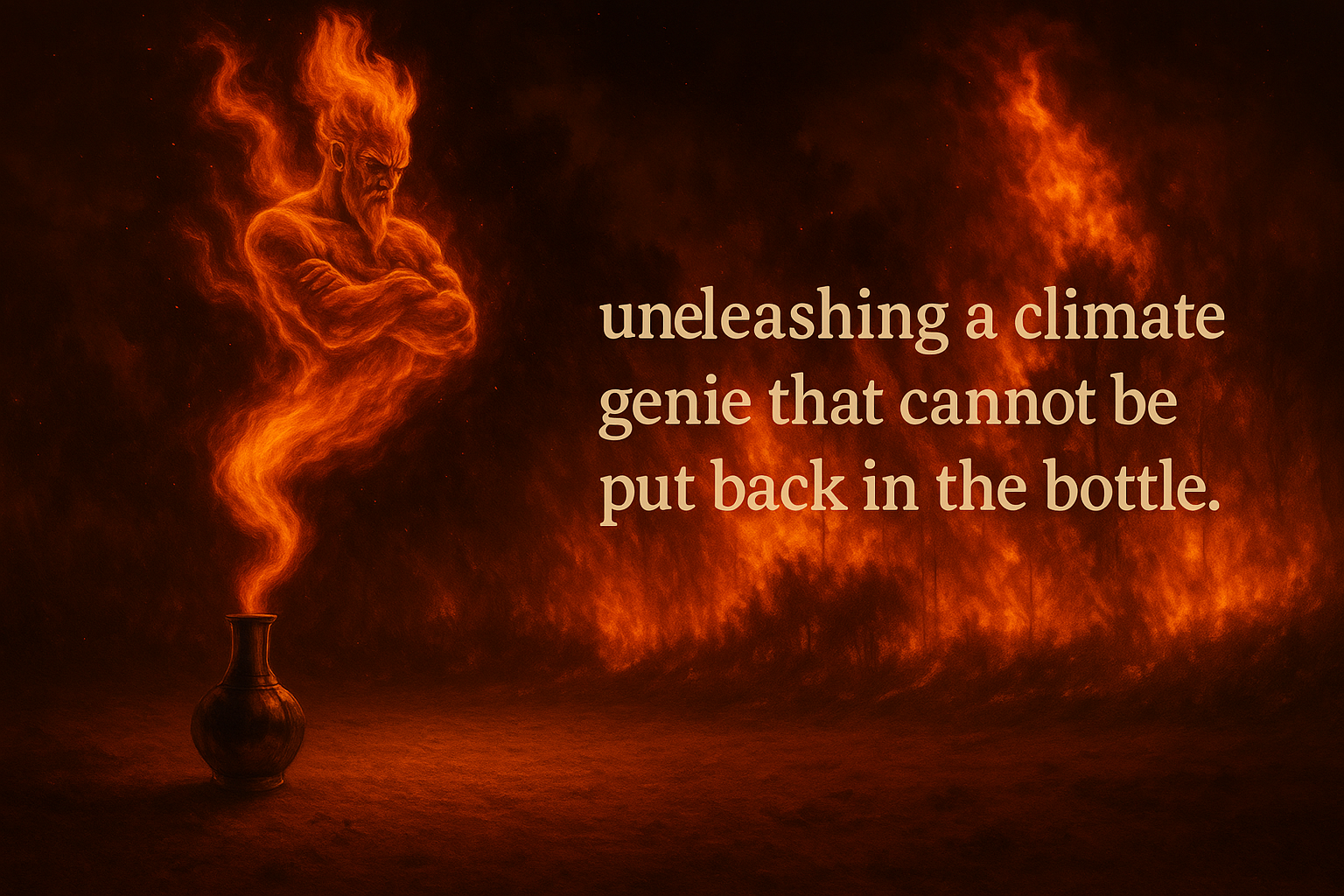
We are on the verge of unleashing a climate
genie that cannot be put back in the bottle. The world must recognize
and protect the irreplaceable carbon sinks of the North before it’s too
late.
Many of us have at least heard of the Tragedy of the Commons, likely as not from an all but forgotten economics class in our youth. Rightly or wrongly I thought the lesson was to show why communal property was likely to be decimated by users over-use of common resources. The example used was un-owned pastures on which the beneficiaries, acting in their own self-interest, put their livestock out to graze. Without ownership there was no oversight as to how many sheep or cattle could be pastured there, and consequently the pasture was trampled and grazed out of existence. The land remained, but the pasture didn’t.
Today we still have “the commons”; communal pastures may be pretty scarce these days, but our oceans, the air we breath, and the stratosphere and climate we all share are the “commons” today. They are not the private property of any individual, government, corporation, or any other entity. I thought I should revisit the lesson of The tragedy of the Commons. Full disclosure: I enlisted the help of Perplexity AI. Here is what it came up with:
Q:Please explain "The Tragedy of the Commons".
A (Perplexity AI):
The Tragedy of the Commons is an economic and
environmental science problem where individuals have access to a shared
resource and act in their own interest, at the expense of other
individuals 6.This can result in overconsumption, underinvestment, and depletion of resources 5. The concept was first presented in an essay written in 1833 by British
economist William Forster Lloyd, and later popularized in a 1968 article
by Garrett Hardin 5.The tragedy of the commons occurs when a resource is rivalrous in
consumption, non-excludable, scarce, and a common-pool resource 2. In other words, it occurs when individuals with access to a public
resource act in their own interest and, in doing so, ultimately deplete
the resource 1.
The tragedy of the commons highlights the conflict between individual and collective rationality 5. Individuals tend to make decisions based on their personal needs, regardless of the negative impact it may have on others 1. In some cases, an individual’s belief that others won’t act in the best
interest of the group can lead them to justify selfish behavior 1. To prevent the tragedy of the commons, there should be some
restrictions to the amount of usage, for example, property rights must
be affixed 6. Exercising restraint would yield benefits for all in the long-term, as the shared resource would remain available 6.
(The numbers are clickable links to the AI's sources)
"...it occurs when individuals [or countries, or corporations] with access to a public resource act in their own interest and, in doing so, ultimately deplete the resource." Deplete what? Our soil? Our oceans? The stratosphere? All of the above? That does indeed sound tragic!
The thing is, there are things we can do to mitigate the damage. We know what they are. There are also reasons those things aren't being done. The problem is political. The problem is that everyone--I mean everyone, rich or poor, wants a "just transition". What constitutes a just transition depends on who you ask and on where they fit into the global scheme of things. Poor countries which have done nothing to cause climate change want compensation for damages caused by climate change--wildfires, droughts, floods, hurricanes, etc. --a polluter-pay proposition; Low-lying and island countries want assurances that they won't be submerged by rising sea levels; Oil workers want new green jobs of equal pay in the new green economy. (Anything less than that would not be construed as a just transition); oil producing countries want to keep producing oil; etc . It is not surprising that after 27 COP summits the inter-governmental panel on climate change (IPCC) is unable to come to a consensus. The United Nations, under whose auspices ICPP falls, is the closest thing we have to a world government, and has been sounding the alarm ever more shrilly with increasing frequency, but to no avail. CO2 emissions continue to rise.
Given the general consensus on the part of COP participants that climate change represents a major threat to all life forms on the planet, one might assume that arriving at a consensus on what to do about it should not be that difficult. Not so. The decision-makers, most of them elected, must take into account how their constituents will respond to whatever they agree to at a COP summit. As such they are unlikely to commit to anything that would hinder their prospects in the next election. For example, here in Canada asking constituents to hand over the keys to their internal combustion vehicles, or to stop flying, is a non-starter. Not even the Green Party would go there. In the case of the former the way of life of most Canadians remains reliant on internal combustion vehicles. In the case of the latter, the tourism industry and airlines, not to mention much of the general public, would find such commitments totally unacceptable. What would be acceptable? Enter net zero emissions.
The genius of net zero targets, usually set for some time well after the next election, is that it allows oil-exporting countries to keep right on exporting oil while still meeting their targets. This is achieved by passing responsibility for emissions from exported fossil fuels on to the end consumer countries. The only emissions oil-exporting countries are responsible for are those that occur on the exporters' own soil. These can be off-set through the acquisition of carbon credits--protected forests, wetlands, carbon capture technology, a reduction in local emissions, etc. This policy was agreed upon, so oil-producing countries are under no obligation to stop extracting and exporting fossil fuels. This may do little to protect the commons--to reduce global emissions, but allows exporting countries to keep right on extracting and exporting. These net zero targets also go a long way toward mollifying increasingly alarmed constituents who are living and/or witnessing the ravages of climate change. Similarly the construction of electric vehicle and battery plants holds out the hope that car-owners can continue to drive uninterrupted, while simultaneously protecting the environment.
Another way of meeting emission targets is by excluding CO2 emissions from the total. This year--2023--the emissions from Canada's wildfires was more than twice the amount resulting from the burning of fossil fuels. Our carbon sinks are turning into carbon sources. The decision to exclude these emissions from the total makes some sense because the increase in frequency, duration, intensity and devastation caused by wildfires cannot be attributed to Canada's emissions alone. Nevertheless they are part of the global total, and as such will not be without consequences.
Whether or not a consensus on the part of all COP participants is necessary is somewhat debatable. While all countries are suffering the consequences of climate change, only a few of them are responsible for the lion's share of emissions. Once again I will enlist the help of Perplexity AI to make my point. (For those of you who are skeptical about the reliability of the AI answers, I encourage you to click on the AI sources--the numbers--and to do your own independent research.) Here is what Perplexity came up with:
Q:How many countries are responsible for the lion's share of GHG emissions? Which countries are the least responsible?
A (Perplexity AI):
According to the search results, a few countries are
responsible for the lion's share of GHG emissions. The US and EU have
caused the most GHG emissions historically, with a combined total of 37%
cumulative emissions globally 2, China, the US, the European Union, India, the Russian Federation, and Japan were the top carbon dioxide (CO2) emitters in 2014 5.
However, when looking at historical emissions per capita, the US and
Russia have the highest per capita emissions, while India's per capita
emissions are the lowest 2.
On the other hand, many of the world's poorest countries are the least polluting but the most climate-vulnerable 3.
The 46 least developed countries (LDCs) were estimated to account for
about 1.1% of total world CO2 emissions from fossil-fuel combustion and
industrial processes in 2019 6. Even in per capita terms, LDCs' CO2 emissions barely reach 9% of the world's average 6.
It seems that an agreement among those few worst polluting countries would go a long way toward engendering an appropriate response to the problem. But that is not going to happen until they are more focused on protecting the environment than they are on protecting their respective economies. There is also the matter of how influential oil industry lobbyists are at these COP summits; they far outnumber many governmental delegations.
So the question remains: Can we prevent the tragedy of our commons--our water, land, and stratosphere--from occurring? Or will what remains of the ecosphere go the way of the dodo bird? The answer is entirely contingent on whether or not the decision-makers stop pursuing their own national, corporate, or individual self-interest, thereby destroying the hand that feeds us; or instead seek and implement solutions that will respect and safeguard all of humanity along with the other lifeforms with which we share this planet. Undoubtedly the planet will survive, but without radical change in priorities on the part of the decision-makers, most life-forms, including humans, will not survive this current tragedy of the commons.
[This article appeared in Bloomberg over a month ago: ( https://www.bloomberg.com/news/features/2023-07-26/massive-carbon-emissions-of-canada-wildfires-are-off-the-scale ). It seems a positive feedback loop has established itself, pretty much guaranteeing that emissions will continue to increase regardless of how many windmills, EVs, solar panels, carbon capture technologies, windmills and nuclear reactors we build. The article was cut and pasted into my blog to circumvent our inability to share posts directly on Facebook and other social media platforms.]
Wildfires Are Set to Double Canada’s Climate Emissions This Year
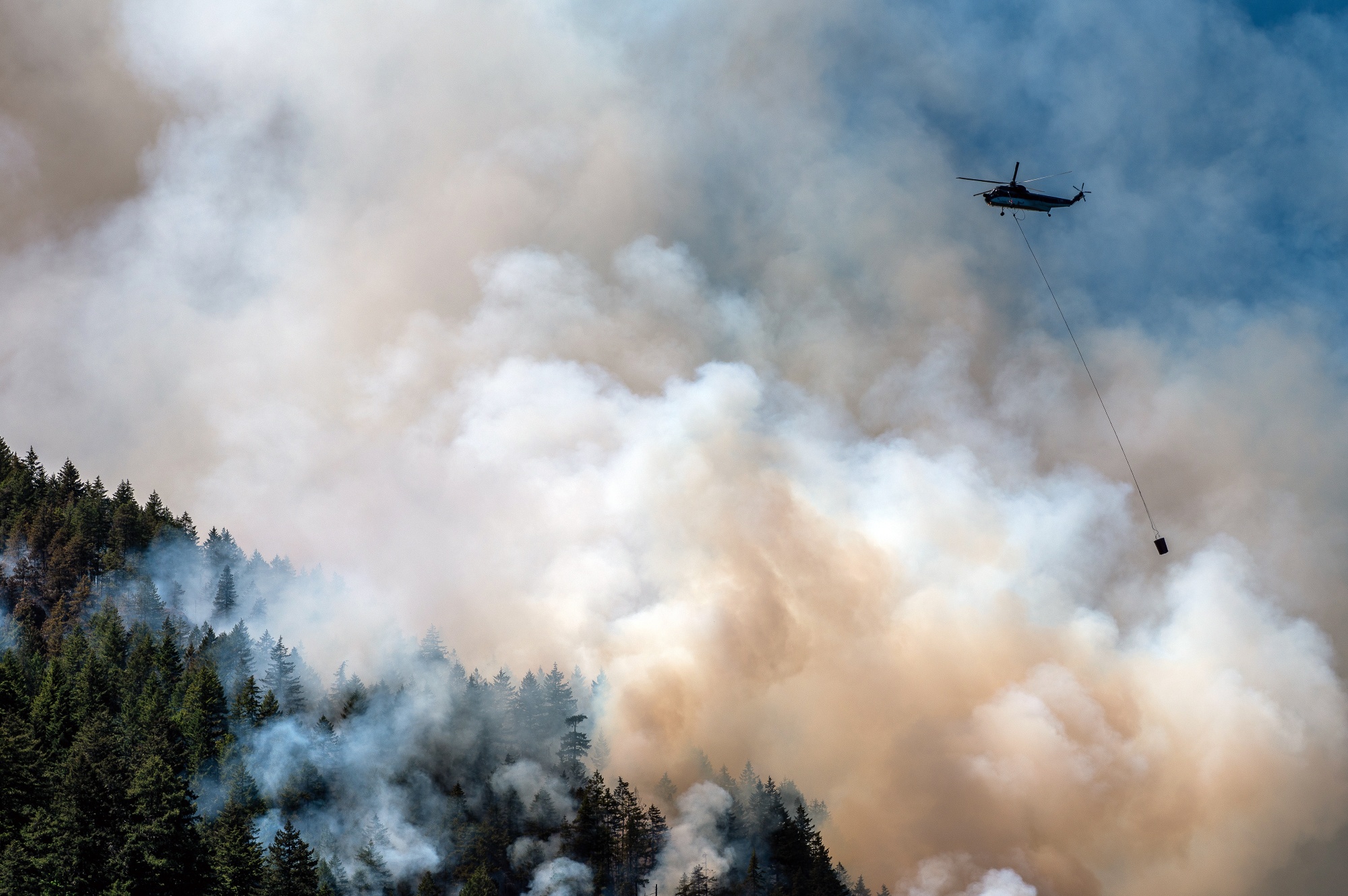
A helicopter waterbomber flies above the Cameron Bluffs wildfire near Port Alberni, British Columbia, on June 6. Photographer: James MacDonald/Bloomberg
The
carbon toll of the country’s fires this year will likely far outweigh
emissions from its oil and gas, transport and agriculture
sectors—combined.
When the greenhouse gases released from Canada’s 2023 wildfires
are eventually tallied, they will be at least double the emissions from
all other sectors of the nation’s economy combined, according to a top
government scientist who has spent three decades measuring the carbon
footprint of forests.
The
2023 emissions are “off the scale” compared to previous years, said
Werner Kurz, a senior research scientist with Natural Resources Canada.
Kurz’s team helped create a carbon budget model for Canada’s forestry
sector which is used by governments and scientists around the world.
A full reckoning won’t be published until 2025. But as of July 18, a preliminary estimate suggests roughly 1,420 millionmetric tons of carbon dioxide equivalent (CO2e)have
been released from the fires so far, across Canada’s managed and
unmanaged forests, Kurz said. By comparison, emissions from all other
sectors of the country’s economy totaled 670 million metric tons of C02e
in 2021, the last year for which full-year figures are available.
This season’s fires have been unprecedented both in terms of pollution — smoke blanketed
major North American cities, shut down airports and crossed the
Atlantic Ocean to Europe — and the staggering scale of territory burned.
Some 11.7 million hectares and counting have ignited, an area larger
than Ohio.
However, the mostfar-reaching impact, only just starting to be understood, is the scale of emissions.
Kurz’s
figure of 1,420 million metric tons includes both managed and unmanaged
forests. Even limiting the scope to managed forests, the amount of
carbon being burned is exponentially higher than in years past going
back to 1990, and roughly equivalent to the annual emissions of Canada
in 2021.
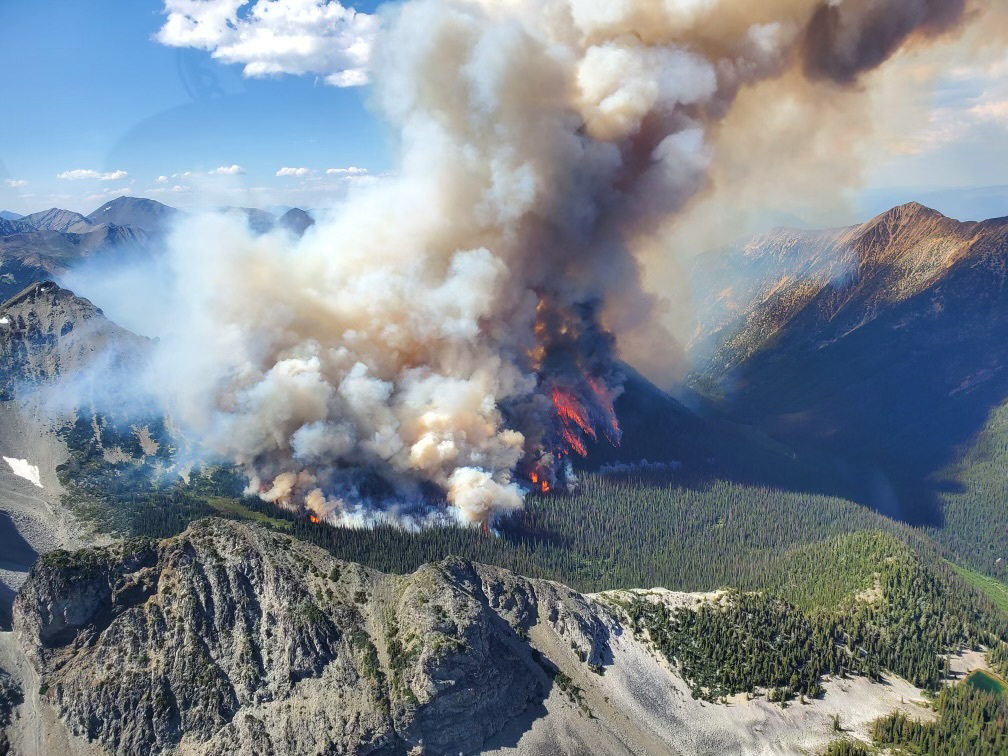
A wildfire in British Columbia on July 10.Source: BC Wildfire Service
Canada’s
vast boreal forests have long been carbon sinks that absorb the
planet-warming gas. This year, continuing the recent trend, the
country’s managed forest will be a source of CO2, releasing more than it
absorbs.
Kurz’s
estimate only covers direct emissions — that is, the GHGs released from
burning trees as well as living and dead organic matter in and on the
soil. But roughly the same amount of indirect emissions will be released
when the dead remnants of scorched trees decompose in coming years, he
says.
Meanwhile, the fire season is barely half over and doesn’t yet show signs of easing.
The
high environmental toll of the fires makes extinguishing them as
quickly as possible a matter of global concern. But in higher North
American latitudes, that’s easier said than done.
In
early June, firefighters began constructing a 20-foot-wide, 8-mile-long
fireguard inside the southern section of Wood Buffalo National Park,
which straddles the border between Alberta and the Northwest
Territories. The task took six days, three bulldozers and two
excavators. The crew used the heavy equipment to clear trees and scrape
back a 5-foot-deep layer of organic material known as “duff” down to
bare sand. It was one of hundreds of fireguards being constructed across
the country: slow, hot, exhausting work.
Less
than a month later, fire had jumped the barrier and the personnel were
headed back to try again, said Katie Ellsworth, a plan section chief
with Parks Canada, currently deployed at Wood Buffalo, who helps in the
preparation for fighting fires.
Typically
those fire guards would have held, but little about this fire season
has been typical, she said. “We’re watching things burn that, by every
textbook and every TED talk and published paper, suggest that they
should not burn — and yet they are.”
The
fires are “aggressive, they’re in the crowns of the trees, they’re
moving from treetop to treetop,” said Ellsworth. Previously burned areas
— which she likens to the charred, tough-to-ignite logs of an old
campfire — are catching fire again. “We’re looking at old burned areas
from 2014 and 2015 and 2018 that, by all accounts and everything we
know, should slow the passage of the fire, and they’re not holding.”
Climate
change is altering the way fires behave, experts say, as extended
periods of record-breaking heat, drought, and high winds create ideal
conditions for wildfires to reach abnormal intensity. Most of the
outbreaks in Canada are the result of lightning strikes, rather than
preventable causes like campfires or sparks from electrical wires
(though those also occur). More intense storms can mean many more
lightning strikes on a single day, often across remote areas that are
hundreds or even thousands of kilometers from airstrips or roads.
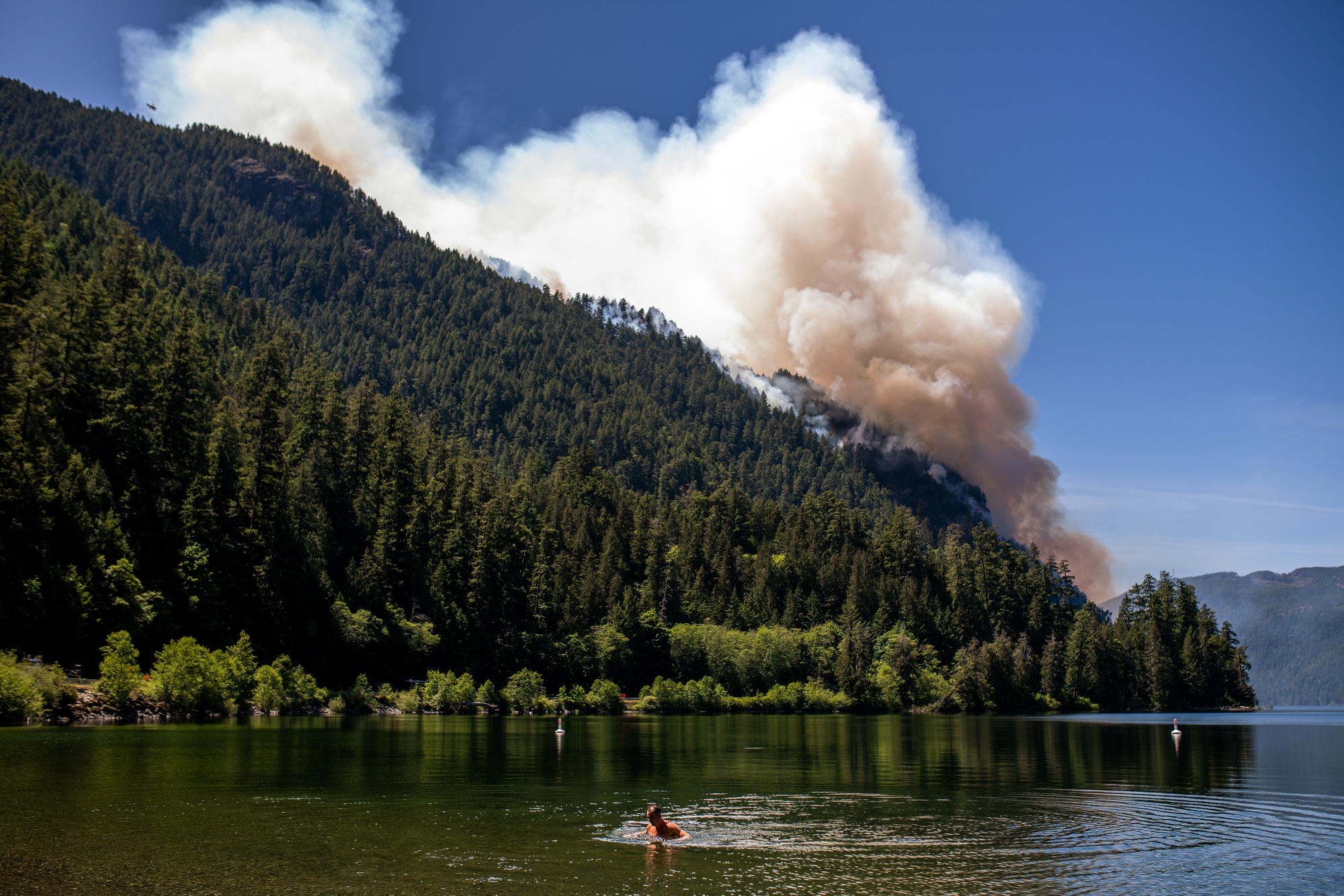
A swimmer in Cameron Lake in front of the Cameron Bluffs wildfire near Port Alberni, British Columbia, on June 6.Photographer: James MacDonald/Bloomberg
The world’s boreal zone
circles the Northern Hemisphere in a vast band that begins just south
of the Arctic Circle. It includes lakes, wetlands and other naturally
treeless areas like mountain tops but also one-third of Earth’s forests.
In Canada, three-quarters of forests are in the boreal zone, covering
307 million hectares, an area larger than Argentina. A vast cache of
biodiversity, it contains half the country’s species of birds and unique
mammals like woodland caribou and is home to many of Canada’s
Indigenous communities.
But
this critically important ecosystem doesn’t respond as well to some of
the standard fire measures used in other parts of the world. In contrast
to the southwestern US, for example, where fires often occur in a mix
of trees and grassland, fire retardant dropped from planes may not reach
flames on the ground because it’s caught by the thick layer of
underbrush and smaller trees often found beneath the boreal canopy.
Also, most of the trees in Canada’s Northern forests are coniferous —
spruce and pine — and highly flammable.
It’s
also vast and remote. By necessity, firefighting efforts in northern
Canada, as well as Alaska, have concentrated on populated areas or areas
with key infrastructure,putting out fires when
possible and redirecting others that threaten to head that way. The rest
are mostly allowed to burn themselves out. When that happens, the value
of the forest as a carbon sink changes to a carbon liability.
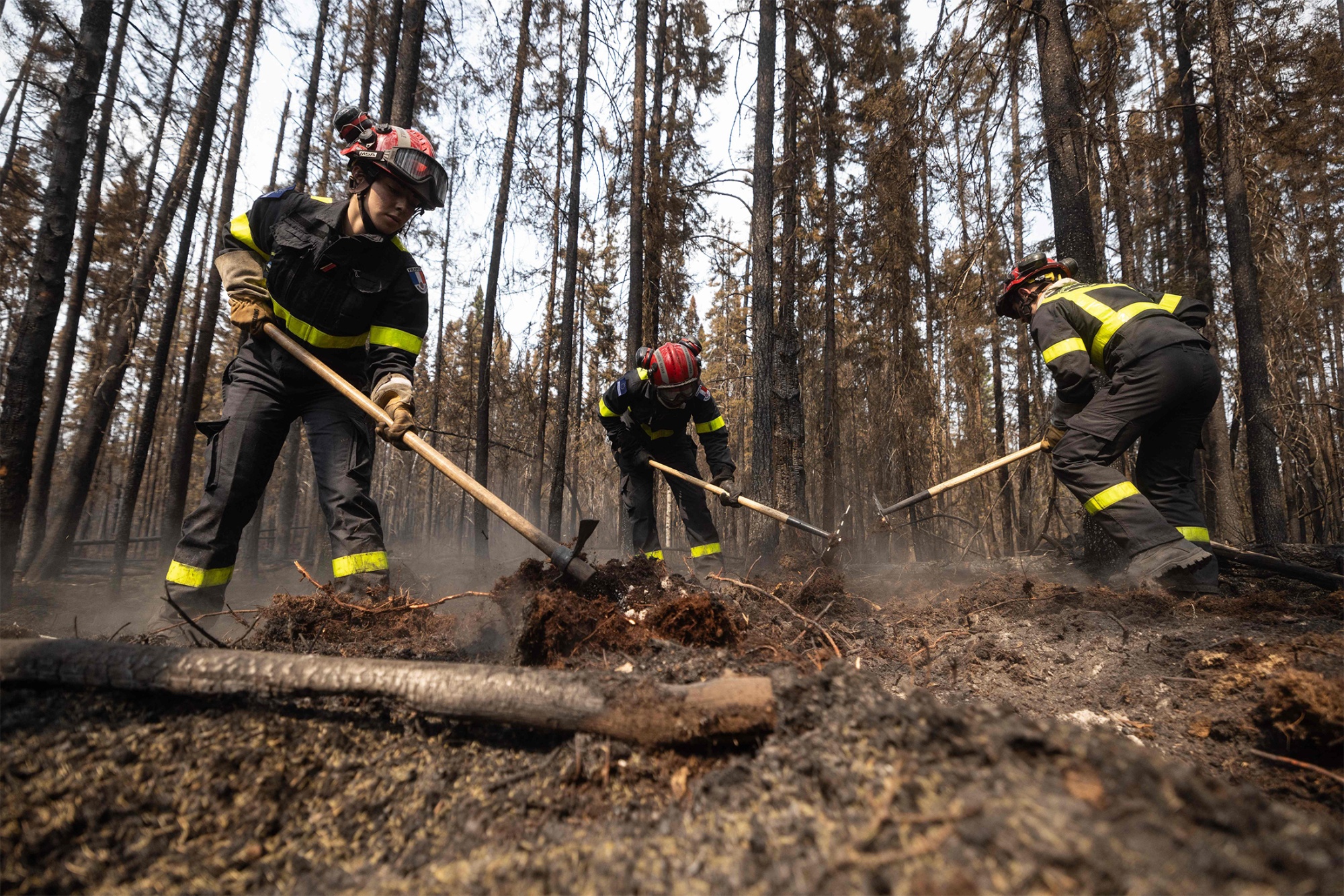
French firefighters battle fires north of the city of Chibugamau, Quebec, Canada, on June 12.Photographer: Quentin Tyberghien/AFP/Getty Images
Accurately
measuring the full carbon footprint of global wildfires is tricky. A
number of variables — including the depth and composition of organic
matter burned, the size and species of dominant trees and what happens
to the forest after the fire — make modeling a challenge. Human
activity, whether tree planting, harvesting, or controlled burns, adds
further complexity, removing and adding carbon to the equations.
Carbon-rich peat,for
example, releases roughly 25% more emissions than regular boreal forest
when burned and can be very difficult to extinguish, smoldering
underground and resurfacing months later. It can also hold a greater
volume of organic material because it is so deep below ground, although
normally the lowest sections don’t ignite.
In northern latitudes, thawing permafrost
is another knock-on effect of wildfires, said Brendan Rogers, an
associate scientist at the Woodwell Climate Research Center in Falmouth,
Massachusetts. Permafrost doesn’t burn — it is too full of frozen water
— but the organic material on top of it can, removing an important
layer of insulation and exposing the permafrost to more heat.“The
permafrost wouldn’t exist except for the organic matter and the
vegetation,” he said. “When you burn that off, what you tend to get in
the years after a fire is that soil warms, the permafrost thaws, and you
get deeper active layers,” which means a thinner layer of permafrost
remains frozen year-round.
Thawing
permafrost releases its own GHGs, including methane, and collapsing
permafrost can create lakes that dissolve and release even more methane.
Meanwhile peatlands — which exist across much of Canada, including in
boreal forests and on permafrost — may be left more flammable after a
fire because they are drier, he said.
Rogers’
research suggests the world is dramatically underestimating the carbon
impact of wildfires. Climate trajectories and carbon budgets are based
on Earth system models that include the impact of fire. However, many of
those global models don’t include direct emissions from burned organic
material under the surface, Rogers says, which his research indicates
represents 80% to 90% of fire emissions in boreal forests, nor do they
include the indirect effects of fire on permafrost. As a result,
projections by leading bodies, including the Intergovernmental Panel on
Climate Change, he said, are “quite conservative.”
Looking
at the amount of carbon the world can burn and still meet Paris
Agreement targets, “10 to 20% of those remaining [carbon] budgets, we’re
estimating, will be eaten upby the combination of
intensifying fire regimes and permafrost thaw, and the interactions
between the two,” he said, referring to the findings of a
soon-to-be-published paper.
That
makes preventing wildfires a matter of global urgency, especially in
vast areas of sequestered carbon. The fuel load of a forest can be
lightened to make it more fire resistant, by clearing away brush,
harvesting small trees or doing a controlled burn. Vast forests can be
broken up by clearing trees to create areas of grassland, while highly
flammable trees, like black spruce, can be replaced with different
native species. More resources can be focused on putting out small fires
in remote areas quickly, rather than allowing them to spread as is the
norm.
Unfortunately,
most of these strategies are very expensive to deploy on a large scale
and may also be less effective as northern climates warm.
“Carbon
content, or risk of carbon emissions, is at the moment not a criterion
for setting firefighting priorities,” said Kurz. “In the northern boreal
there are few people, there are few roads, there are few airports.
There is just not the infrastructure to effectively fight fires. And so
while it would be really good to do this from a climate perspective, the
actual feasibility of doing so is going to be very challenging.”