Tuesday, September 5, 2023

Wildfires Are Set to Double Canada’s Climate Emissions This Year

 [This article appeared in Bloomberg over a month ago:
( https://www.bloomberg.com/news/features/2023-07-26/massive-carbon-emissions-of-canada-wildfires-are-off-the-scale ). It seems a positive feedback loop has established itself, pretty much guaranteeing that emissions will continue to increase regardless of how many windmills, EVs, solar panels, carbon capture technologies, windmills and nuclear reactors we build. The article was cut and pasted into my blog to circumvent our inability to share posts directly on Facebook and other social media platforms.]

Wildfires Are Set to Double Canada’s Climate Emissions This Year
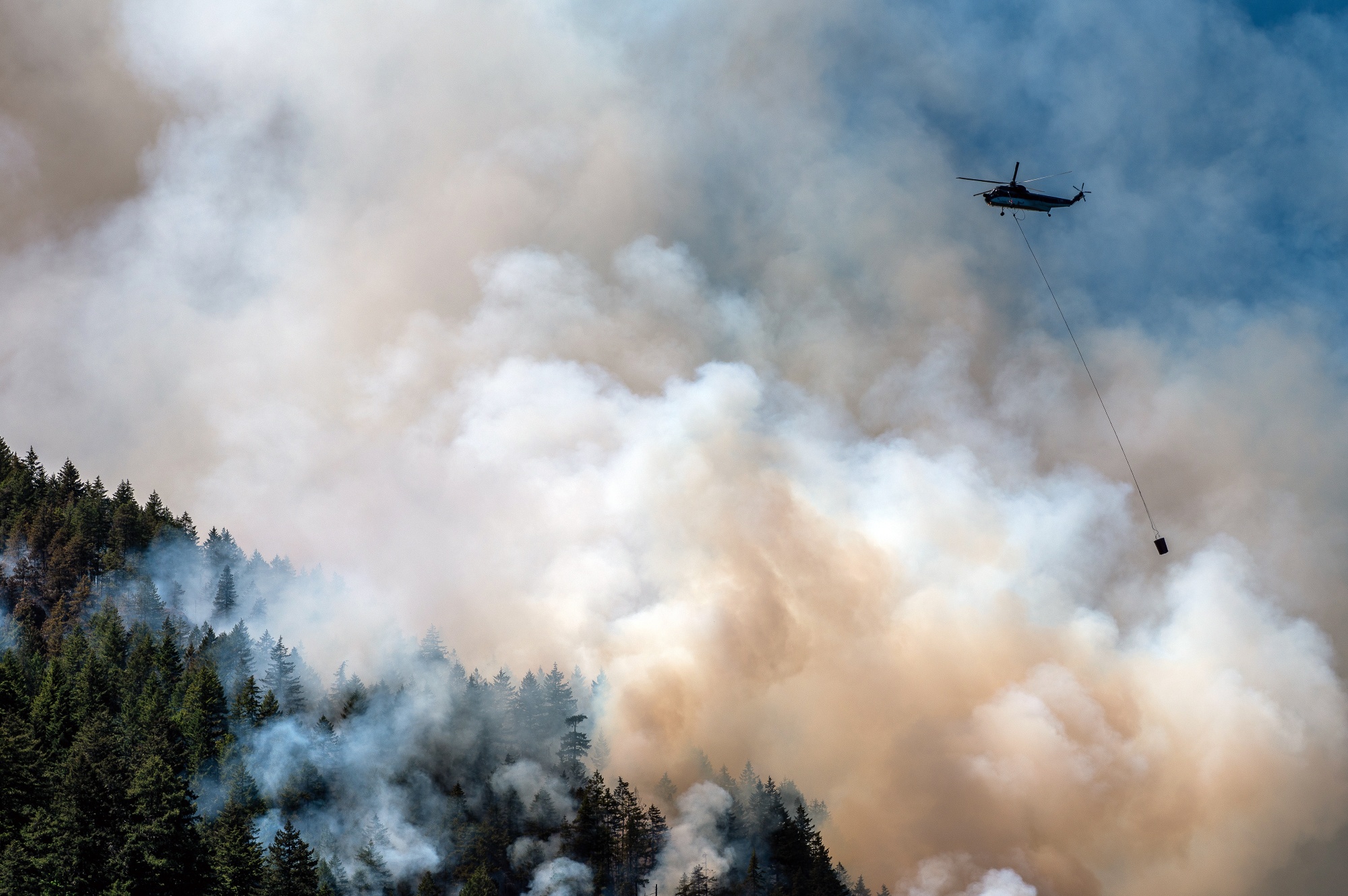
A helicopter waterbomber flies above the Cameron Bluffs wildfire near Port Alberni, British Columbia, on June 6. 

A helicopter waterbomber flies above the Cameron Bluffs wildfire near Port Alberni, British Columbia, on June 6. Photographer: James MacDonald/Bloomberg

The carbon toll of the country’s fires this year will likely far outweigh emissions from its oil and gas, transport and agriculture sectors—combined.

The 2023 emissions are “off the scale” compared to previous years, said Werner Kurz, a senior research scientist with Natural Resources Canada. Kurz’s team helped create a carbon budget model for Canada’s forestry sector which is used by governments and scientists around the world.

A full reckoning won’t be published until 2025. But as of July 18, a preliminary estimate suggests roughly 1,420 million metric tons of carbon dioxide equivalent (CO2e) have been released from the fires so far, across Canada’s managed and unmanaged forests, Kurz said. By comparison, emissions from all other sectors of the country’s economy totaled 670 million metric tons of C02e in 2021, the last year for which full-year figures are available. 


This season’s fires have been unprecedented both in terms of pollution — smoke blanketed major North American cities, shut down airports and crossed the Atlantic Ocean to Europe — and the staggering scale of territory burned. Some 11.7 million hectares and counting have ignited, an area larger than Ohio.

However, the most far-reaching impact, only just starting to be understood, is the scale of emissions.

Kurz’s figure of 1,420 million metric tons includes both managed and unmanaged forests. Even limiting the scope to managed forests, the amount of carbon being burned is exponentially higher than in years past going back to 1990, and roughly equivalent to the annual emissions of Canada in 2021. 
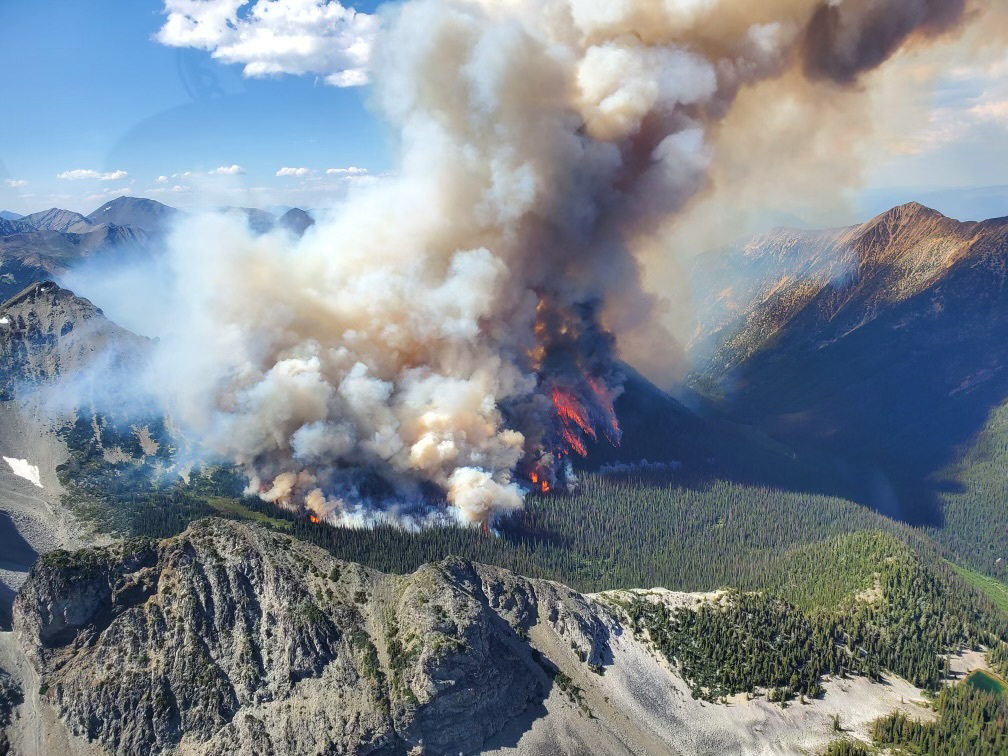

A wildfire in British Columbia on July 10.Source: BC Wildfire Service

Canada’s vast boreal forests have long been carbon sinks that absorb the planet-warming gas. This year, continuing the recent trend, the country’s managed forest will be a source of CO2, releasing more than it absorbs.

Kurz’s estimate only covers direct emissions — that is, the GHGs released from burning trees as well as living and dead organic matter in and on the soil. But roughly the same amount of indirect emissions will be released when the dead remnants of scorched trees decompose in coming years, he says.


Meanwhile, the fire season is barely half over and doesn’t yet show signs of easing.

The high environmental toll of the fires makes extinguishing them as quickly as possible a matter of global concern. But in higher North American latitudes, that’s easier said than done.

In early June, firefighters began constructing a 20-foot-wide, 8-mile-long fireguard inside the southern section of Wood Buffalo National Park, which straddles the border between Alberta and the Northwest Territories. The task took six days, three bulldozers and two excavators. The crew used the heavy equipment to clear trees and scrape back a 5-foot-deep layer of organic material known as “duff” down to bare sand. It was one of hundreds of fireguards being constructed across the country: slow, hot, exhausting work.

Less than a month later, fire had jumped the barrier and the personnel were headed back to try again, said Katie Ellsworth, a plan section chief with Parks Canada, currently deployed at Wood Buffalo, who helps in the preparation for fighting fires.

Typically those fire guards would have held, but little about this fire season has been typical, she said. “We’re watching things burn that, by every textbook and every TED talk and published paper, suggest that they should not burn — and yet they are.”

The fires are “aggressive, they’re in the crowns of the trees, they’re moving from treetop to treetop,” said Ellsworth. Previously burned areas — which she likens to the charred, tough-to-ignite logs of an old campfire — are catching fire again. “We’re looking at old burned areas from 2014 and 2015 and 2018 that, by all accounts and everything we know, should slow the passage of the fire, and they’re not holding.”

Climate change is altering the way fires behave, experts say, as extended periods of record-breaking heat, drought, and high winds create ideal conditions for wildfires to reach abnormal intensity. Most of the outbreaks in Canada are the result of lightning strikes, rather than preventable causes like campfires or sparks from electrical wires (though those also occur). More intense storms can mean many more lightning strikes on a single day, often across remote areas that are hundreds or even thousands of kilometers from airstrips or roads.
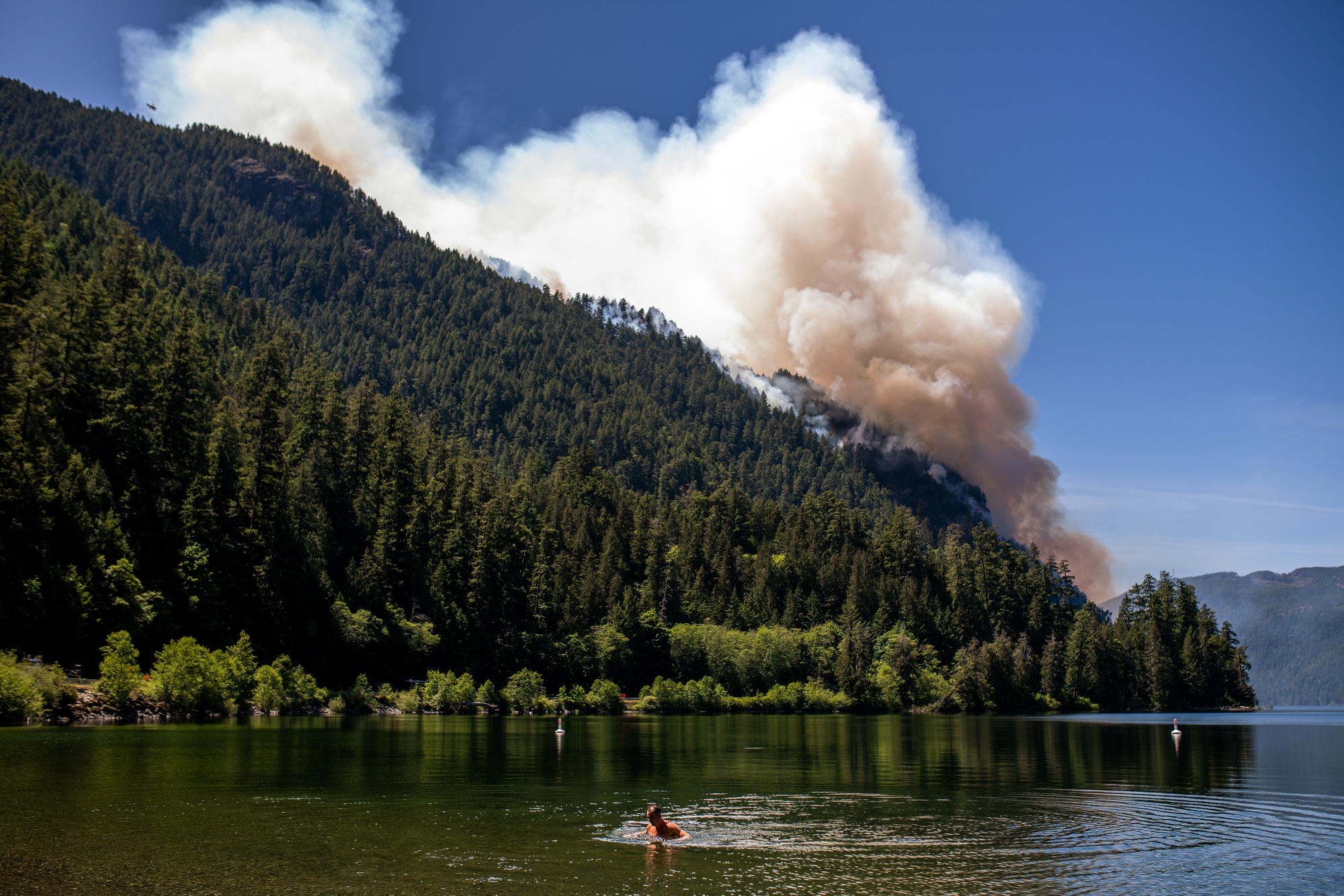
A swimmer in Cameron Lake in front of the Cameron Bluffs wildfire near Port Alberni, British Columbia, on June 6.Photographer: James MacDonald/Bloomberg

The world’s boreal zone circles the Northern Hemisphere in a vast band that begins just south of the Arctic Circle. It includes lakes, wetlands and other naturally treeless areas like mountain tops but also one-third of Earth’s forests. In Canada, three-quarters of forests are in the boreal zone, covering 307 million hectares, an area larger than Argentina. A vast cache of biodiversity, it contains half the country’s species of birds and unique mammals like woodland caribou and is home to many of Canada’s Indigenous communities.

But this critically important ecosystem doesn’t respond as well to some of the standard fire measures used in other parts of the world. In contrast to the southwestern US, for example, where fires often occur in a mix of trees and grassland, fire retardant dropped from planes may not reach flames on the ground because it’s caught by the thick layer of underbrush and smaller trees often found beneath the boreal canopy. Also, most of the trees in Canada’s Northern forests are coniferous — spruce and pine — and highly flammable.

It’s also vast and remote. By necessity, firefighting efforts in northern Canada, as well as Alaska, have concentrated on populated areas or areas with key infrastructure, putting out fires when possible and redirecting others that threaten to head that way. The rest are mostly allowed to burn themselves out. When that happens, the value of the forest as a carbon sink changes to a carbon liability.
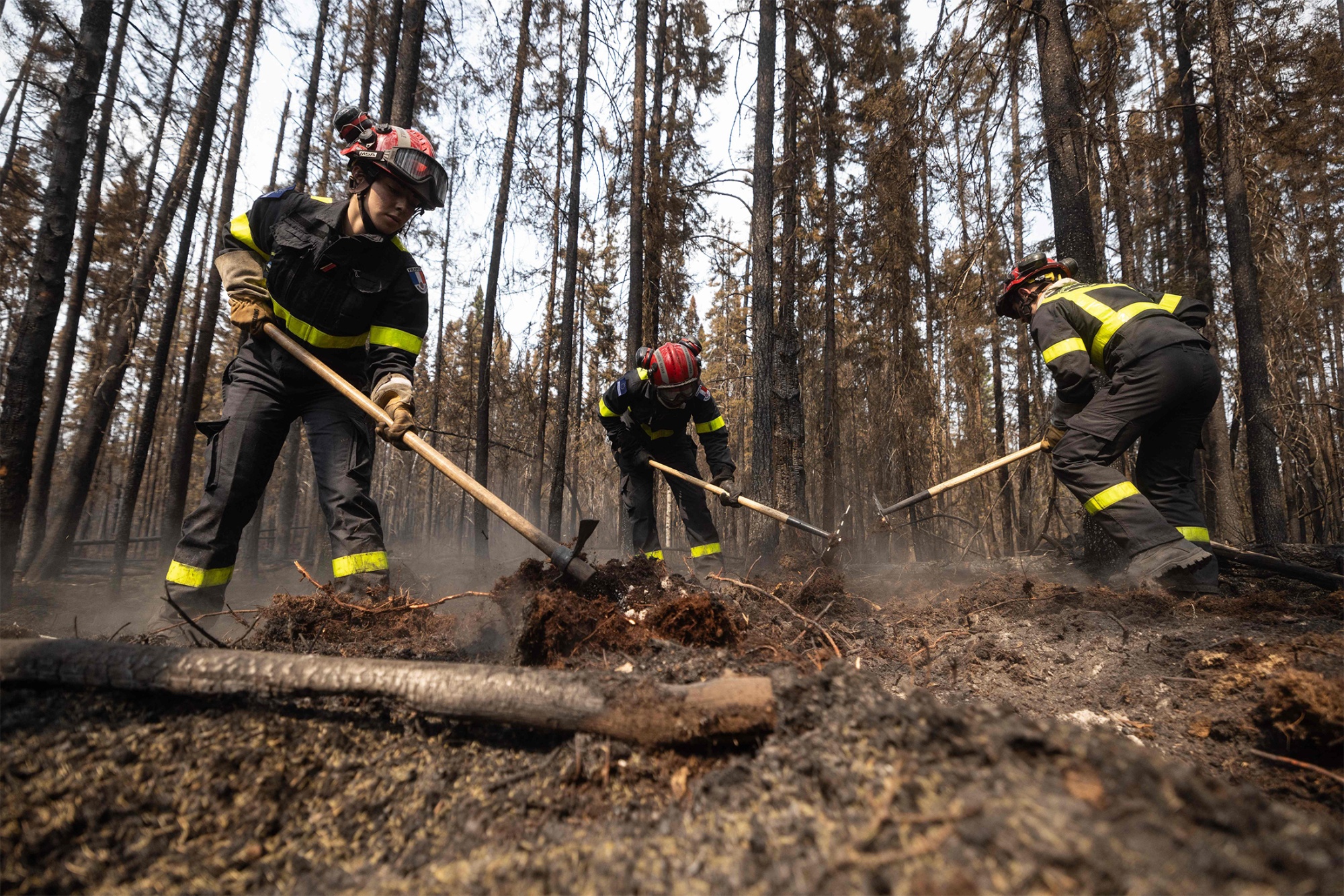
French firefighters battle fires north of the city of Chibugamau, Quebec, Canada, on June 12.Photographer: Quentin Tyberghien/AFP/Getty Images

Accurately measuring the full carbon footprint of global wildfires is tricky. A number of variables — including the depth and composition of organic matter burned, the size and species of dominant trees and what happens to the forest after the fire — make modeling a challenge. Human activity, whether tree planting, harvesting, or controlled burns, adds further complexity, removing and adding carbon to the equations.

Carbon-rich peat, for example, releases roughly 25% more emissions than regular boreal forest when burned and can be very difficult to extinguish, smoldering underground and resurfacing months later. It can also hold a greater volume of organic material because it is so deep below ground, although normally the lowest sections don’t ignite.

In northern latitudes, thawing permafrost is another knock-on effect of wildfires, said Brendan Rogers, an associate scientist at the Woodwell Climate Research Center in Falmouth, Massachusetts. Permafrost doesn’t burn — it is too full of frozen water — but the organic material on top of it can, removing an important layer of insulation and exposing the permafrost to more heat. “The permafrost wouldn’t exist except for the organic matter and the vegetation,” he said. “When you burn that off, what you tend to get in the years after a fire is that soil warms, the permafrost thaws, and you get deeper active layers,” which means a thinner layer of permafrost remains frozen year-round.

Thawing permafrost releases its own GHGs, including methane, and collapsing permafrost can create lakes that dissolve and release even more methane. Meanwhile peatlands — which exist across much of Canada, including in boreal forests and on permafrost — may be left more flammable after a fire because they are drier, he said.

Rogers’ research suggests the world is dramatically underestimating the carbon impact of wildfires. Climate trajectories and carbon budgets are based on Earth system models that include the impact of fire. However, many of those global models don’t include direct emissions from burned organic material under the surface, Rogers says, which his research indicates represents 80% to 90% of fire emissions in boreal forests, nor do they include the indirect effects of fire on permafrost. As a result, projections by leading bodies, including the Intergovernmental Panel on Climate Change, he said, are “quite conservative.”

Looking at the amount of carbon the world can burn and still meet Paris Agreement targets, “10 to 20% of those remaining [carbon] budgets, we’re estimating, will be eaten up by the combination of intensifying fire regimes and permafrost thaw, and the interactions between the two,” he said, referring to the findings of a soon-to-be-published paper.

That makes preventing wildfires a matter of global urgency, especially in vast areas of sequestered carbon. The fuel load of a forest can be lightened to make it more fire resistant, by clearing away brush, harvesting small trees or doing a controlled burn. Vast forests can be broken up by clearing trees to create areas of grassland, while highly flammable trees, like black spruce, can be replaced with different native species. More resources can be focused on putting out small fires in remote areas quickly, rather than allowing them to spread as is the norm.

Unfortunately, most of these strategies are very expensive to deploy on a large scale and may also be less effective as northern climates warm.

“Carbon content, or risk of carbon emissions, is at the moment not a criterion for setting firefighting priorities,” said Kurz. “In the northern boreal there are few people, there are few roads, there are few airports. There is just not the infrastructure to effectively fight fires. And so while it would be really good to do this from a climate perspective, the actual feasibility of doing so is going to be very challenging.”


Sunday, August 6, 2023

Past the Tipping Point:

Here in Canada we are now past the tipping point. Even if we eliminate emissions from all other sources, wildfires alone put us well over our emission targets. A positive feedback loop in which this year's emissions get added to the accumulated emissions from previous years/decades/centuries, ensure that next year's temperatures will be even higher, drying out even more forests and tundra, melting even more permafrost, turning it all into kindling for next year's fires, thereby ensuring that they will be more numerous and ferocious than this year's fires. And so on.

None of this will be immediately apparent to most people because powerful interests don't want it to be. We are constantly being fed a steady diet of claptrap to bamboozle us and to lull us into an unwarranted sense of complacency. First and foremost, emissions from wildfires are not included in the tally of Canada's emissions because they are considered carbon neutral--the vegetation will grow back and reabsorb any GHG emissions released by a fire; and secondly, because wildfires are not considered to be anthropomorphic (caused by humans). But discounting them does not make these emissions go away, just as exporting fossil fuels doesn't mean that they don't get burnt elsewhere and contribute to global warming. A realistic prognosis for the planet must include all GHG emissions, whether someone accepts responsibility for them or not. GHG emissions are a global problem, and as such national solutions are limited.

Some wildfires are not anthropomorphic. Wildfires predate the industrial revolution and the burning of fossil fuels. But the increased intensity, frequency, size and number of wildfires is indeed anthropomorphic--exacerbated by global warming. The importance of this cannot be exaggerated; the emissions from wildfires in Canada have now eclipsed emissions from all other sources. Our once enviable carbon sinks have become liabilities--primary sources of GHG emissions. Discounting and excluding wildfire emissions from the total tally gives a very deceptive and dangerously misleading indication of where we're really at. 


We hear a great deal about emission reduction plans: Solar energy, wind energy, new nuclear plants, car battery plants for EVs, carbon capture technologies, etc. Despite all these, even excluding wildfire emissions and exported fossil fuels from the mix, our total GHG emissions have continued to rise. Nothing that has been done to date has lowered our GHG emissions. On the contrary. Adding wildfire emissions to the mix more than doubles Canada's total emissions. No proffered solution can reduce emissions by the amount required. 

Just a cursory examination of the most popular climate solutions reveals that all of them are intended, not only to reduce emissions, but also to make business as usual possible; the new "green" economy is intended to allow for continued capitalist expansion and perpetual economic growth. Replacing "zero" emission targets with "net zero" targets allows fossil fuel exporting countries to keep on exporting as long as they have enough carbon credits to do so. Under "net zero" there is no requirement to leave fossil fuels in the ground as long as you have enough carbon credits to offset any emissions in the process of extracting them. Carbon credits are acquired by sequestering carbon, either by planting and/or purchasing swamps and forests, or by installing carbon capture technology to capture emissions at the source--at a coal-fired power plant for instance. The responsibility for any CO2 emissions that occur after export falls to whichever country burns them. Of course this does nothing to reduce global emissions, but it does effectively protect fossil fuel exporters from liability while continuing to extract and export fossil fuels. Even banks can reach net zero while financing the fossil fuel industry as long as they have enough carbon credits to offset emissions that occur in their offices. Even the mineral extraction industry is re-branding itself as "green", not because of lowering its CO2 emissions, but because minerals for EV batteries, solar panels and windmills are needed in the new "green" economy. None of this has reduced the total global emissions, or even that of a particular country, but nonetheless seems to be convincing a lot of people that real effective work on reducing emissions is being done in a timely manner. Not so!

https://miningir.com/wp-content/uploads/deepgreen_metals.jpg
DeepGreen mining seafloor

Now, even ignoring all other sources of GHG emissions, wildfires by themselves are enough to ensure a climate holocaust. Given the positive feedback loop described above, we can only expect the damage caused by wildfires to continue to grow exponentially, regardless of what we do. Only an actual reduction in global temperatures could interrupt our invincible defeat. Perhaps if we had decoupled climate action from economic growth ten, twenty or thirty years ago we could have reduced emissions enough prevent the positive feedback loop now fuelling wildfires. We didn't.

--by Stewart Vriesinga

Monday, April 17, 2023

The Great Net Zero Green-Washing Deception: A Path to Oblivion

"Net Zero" has become the new buzzword for setting emission targets. Countries and corporations alike have set net zero emission targets to convince us that they are "doing their part" to reduce global emissions. But what is net zero exactly? Are they really doing their part? What, exactly, is the difference between net zero and zero emissions? Instead of reducing emissions to zero, with net zero one can buy a license to emit through the purchase of carbon offsets. But this leads us to the next question: What are carbon offsets?

Carbon offsets are devices that capture and sequester carbon. Some offsets are biological, some are technological. The former includes things like forests, wetlands, peat reserves, etc. These can be purchased and protected, locally or abroad, or created through reforestation and reclaiming of wetlands etc. 

Technological carbon offsets are ways of capturing carbon at the source of emission, or removing it from the atmosphere. The latter has not yet been achieved on a large scale, but is being invested in by corporations and countries on the assumption that they can developed in time for them to meet their net net zero emission targets. Theoretically captured carbon must somehow be sequestered in a way that it cannot be re-released into the atmosphere. This is usually done using deep underground deposits, often utilizing already depleted oil wells. 

The main problem with net zero emission targets is that they do little to discourage global consumption of fossil fuels; they only provide incentives to reduce those emissions emitted in a particular country or by a particular corporation. Fossil fuels extraction intended for export markets can continue unabated provided they exporters are, or assumed will be in possession of enough carbon offsets to offset emissions that occur as a result of extraction. This allows a corporation or country to meet its emission targets while continuing to extract fossil fuels for export, because it disregards emissions that occur after export. Once the fuels are out of their domain--once they have been exported to other end users--it is no longer the extractor's responsibility; it is the purchasers who must account for those emissions. Net zero emissions are extremely attractive to fossil fuel exporting countries and corporations. Exxon Mobile is one example of this: 

The plant’s main function is to process natural gas from a nearby deposit. But in order to purify and sell the gas, Exxon must first strip out carbon dioxide, which comprises about two-thirds of the mix of gases extracted from nearby wells.

The company found a revenue stream for this otherwise useless, climate-warming byproduct: It began capturing the CO2 and selling it to other companies, which injected it into depleted oil fields to help produce more oil.

--Inside Climate News

Oil companies have found a way, not only to meet their net zero emission targets, but to make a handsome profit while they're at it by cashing in on generous government subsidies for emission reductions,  while also selling the carbon they've captured to smaller companies who pump it into depleted wells to extract even more oil! This double-dipping actually increases global fossil fuel consumption rather than reducing it.  

The oil industry is not the only one to use deceptive accounting methods. Banks, for instance, can set a few solar panels on the roof and maybe hook up a couple of other alternative energy sources, and then claim to be carbon neutral, while their huge loans to fossil fuel industries continue uninterrupted. Net zero targets take the onus for emission reductions off of the fossil fuel and other industries in possession of carbon offsets, and externalizes  responsibility for these emissions to countries who import fossil fuels, in much the same way that industry is outsourced to overseas supply chains to reduce labour costs, avoid taxes, worker protection laws, and local environmental standards, etc. 

The problem with this nationalistic approach is that global warming is a global phenomenon. Corporations and nation states externalizing the cost of carbon emissions is not going to reduce global emissions. We all live on the same planet. And countries that must import fossil fuels and sell off their own carbon offsets--forests, wetlands, etc.-- are usually less able to bear the costs of transitioning to cleaner renewable energy than the countries they import the fuel from. Similarly, large oil producers are selling off their most carbon intensive operations to smaller wholly-owned private operators who do not trade on the stock market and are therefore not subjected to same scrutiny and regulations. Furthermore, divesting themselves of carbon intensive holdings qualifies these large global operators for huge government subsidies as a reward for "reducing" their carbon emissions:

The Baytown Exxon gas refinery produces the more processed oil than any other facility in the United States on March 23, 2006 in Baytown, TX. (Photo by Benjamin Lowy/Reportage by Getty Images)


Exxon Touts Carbon Capture as a Climate Fix, but Uses It to Maximize Profit and Keep Oil Flowing

The company sells the CO2 to other companies that use it to revive depleted oil fields and has relentlessly fought EPA oversight of the practice.

In 2008, when concerns about climate change led Congress to pass a tax credit meant to encourage companies to capture and store carbon dioxide, Exxon was presented with another way to make money from the technology. The massive amounts of carbon dioxide captured at its Wyoming facility put the oil and gas giant in a position to claim more credits under the tax break than any other company.

In the ensuing years, Exxon may have claimed hundreds of millions of dollars in tax credits, according to estimates based on publicly available data from the Internal Revenue Service, the Securities and Exchange Commission, and a global think tank that tracks the technology.

--Inside Climate News

So, as we can see, Net Zero targets are a clever and useful way of accounting for, or, more precisely, not accounting for carbon emissions. Consequently those who want to appear serious about reducing their carbon emissions may in reality be doing little if anything at all to reduce global emissions. Are there better ways of measuring, accounting for, and reducing fossil fuel emissions? Ways of more accurately measuring a country's global carbon footprint and setting emissions targets accordingly? Yes, there certainly are!

A big part of the problem is that instead of recognizing and naming climate change as a cost of production, the cost has been externalized. Wealthy and fossil fuel producing nations are using net zero targets, not as a way of reducing global emissions, but rather transferring responsibility for existing emissions onto poorer countries and pretending that this somehow will reduce global emissions. It won't. Just as offshoring production is used to reduce the cost of labour, so too offshoring responsibility for CO2 emissions from fossil fuel producers to fossil fuel consumers obfuscates the true cost of extraction. The former will reduce the cost of labour for production, while the latter will reduce the cost of fossil fuel extraction by transferring responsibility for emissions from sellers to buyers. Offshoring production costs does not reduce the global amount of labour required to produce a commodity; it may increase it if reduced labour costs forestall automation. So too, offshoring fossil fuel extraction and consumption costs to end consumers does not reduce the total amount of global emissions. The consequences this faulty net zero accounting are largely borne by those least responsible for CO2 emissions, and those least able to afford it. By off-loading responsibility for emissions onto those least able to afford it, instead of reducing global emissions net zero targets actually increase emissions. 

Not only does this practice increase emissions; they constitute a grave injustice to those who suffer the consequences of global warming and climate change. If the car we are driving jumps the curb and kills innocent pedestrians we expect the driver to take responsibility, and insofar as compensation for damages the driver is liable. Why should it be any different for for the drivers of CO2 emissions?