Friday, February 21, 2025

The Coup, the Broligarchy and the New World Order

We're going to have a hard time getting the attention, sympathy and collaboration of our American friends for a while. They're very busy trying to undo a coup.
 

Protesting the coup

To understand the radical changes in the US foreign policy one must first understand the radical changes that have and are taking place in America domestically. There’s been a coup. It is, as yet, incomplete. Trump and a very small cohort of technocrat centi-billionaires (referred to hereafter as the broligarchy) are taking control of the country. The rule-based approach to both domestic and foreign policy has been replaced with a transactional approach.

Internationally relations with other countries will be negotiated solely basis of their power relative to the US. The disparity in power between weaker and dependent nations will be monetized, irrespective of what those relations were historically. For instance, nations that are heavily dependent on access to US markets will have to pay for that access, either with tariffs, or other concessions. Wealthier trading partners will be able to negotiate better terms. Canada and Mexico will initially have to pay 25% tariffs for access, while relatively powerful China will only have to pay 10% tariffs. Historical enemies like Russia won’t be treated any differently than historical allies. There are no moral or ideological underpinnings or restrictions here. If a deal with Russia is lucrative, while financing Ukraine’s war on Russia is not, Ukraine will be thrown under the bus, irrespective of how NATO partners feel about it. The spoils will be divided. Trump et al have proposed that Ukraine repay the US for previously supplied weapons with 50% or more of their critical minerals. Russia benefits from the crippling of NATO and the normalizing of relations. NATO and other European countries will not be able to defend themselves from further Russian aggression without US support. Nato members will either have to dramatically increase their defence spending in support of NATO to appease the US, or come up with an alternative defence force of their own. Both options would put billions into the coffers of US arms manufacturers because at present European arms manufacturers don’t have the capacity to replace US arms. Additionally, they would have to replace thousands of US troops and military bases in Europe, who, in any case, are unlikely to be deployed against the new trading partner –Russia. Thus the imbalance of military might between the US and its former allies will also be monetized.

Domestically entities and agencies that cost money rather than make money are being dismantled at an alarming rate. So are the checks and balances intended to prevent the abuse of authority. It’s all part of Musk’s and his bros' –the broligarchy– plans to reduce government spending by at least one trillion dollars. Despite never having been elected or vetted Musk was placed in charge of the newly created Department of Government Efficiency (DOGE), accountable to no one, but nonetheless with an office in the White House. Already many government agencies that provided essential services have been dismantled, or soon will be, as alarmed opponents desperately scramble to get temporary judicial restraining orders. Additionally, tens of thousands of experienced public servants are being fired, including judges from the Department of Justice. (Some of these dismissals may be more about punishing those who ruled against Trump or Musk rather than about saving money.) Congress seems to be completely subordinated to the Executive Branch, as demonstrated by two occasions in which Trump and Musk blocked government spending bills despite the bills having had bilateral support. The daily protests by thousands of government employees and other concerned citizens seem to be ineffectual. –Should the need arise, Trump has contingency plans in placeto mobilize the National Guard and other state security forces to squelch dissent–the enemy within. Meanwhile, the resulting domestic crisis is diverting attention away from the massive changes in foreign relations.

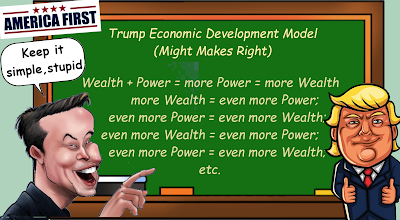
The threat of tariffs and annexation of Canada is real, although the latter may be unlikely, (More on that later) But appeals based on the previous rule-based world order, or to sympathetic American consumers and businesses who would also be adversely affected by tariffs, are futile. In the case of the former, simply because the rules of the previous rule-based world order are no longer in place. The premise of the second is that Trump might be dissuaded by the pain his actions will cause fellow Americans. The history of his previous term in office, and all of his actions to date in this term, indicate that he doesn’t care one iota about the pain caused to his compatriots. As long as the pain is somebody else’s, he can live with it, Maybe he even get some perverse sadistic pleasure out of watching people plead, grovel and whimper. As long as it doesn’t interrupt the accumulation and consolidation of the wealth and power of the Broligarchy it is okay. Under this rubric, there is no appeasing Trump et al. More wealth results in additional power. Additional power provides the means to exact even more concessions and raise tariffs even higher, in an endless positive feedback loop. Giving the bully your lunch money won’t stop him from coming back for more, again and again. This applies as much to external affairs as it does to domestic ones.

The whole scheme is analogous to another such scheme most of us are less cognizant of: the relations between wealthy countries and less-developed countries (LDCs) in the global rule-based economy. Contrary to the popular belief that wealthy nations are wealthy because of merit –our superior technology, our work ethic, our ingenuity, etc.– we are also monetizing and exploiting an imbalance of power. The rules that benefit us are not some natural phenomenon predetermined by natural laws of nature or an invisible hand; they are rules created and enforced by global institutions. Institutions that wealthy countries and corporations have created to maintain and exploit their power over LDCs. These institutions include the World Trade Organization (WTO), International Monetary Fund (IMF), World Bank, NATO, and the G7, USAID, to name but a few. The difference between this and Trump’s transactional bilateral approach is that the rule-based world order befitted wealthy nations collectively at the expense of LDCs, while Trump’s transactional might-makes-right approach deals with countries individually. This transactional approach eliminates the need for all these aforementioned institutions needed in the rules-based economy to create, maintain and enforce a favourable rule-based world order. For the broligarchy’s purposes, such rules are superfluous –unnecessary and unjustifiable expenses.

In some ways, Trump’s approach is more akin to the rule of the imperial colonial global powers of old. In that epoch, other countries were subjugated and colonized through the use of military might, in the name of God and King. However, post WWII, most of these colonies were granted “independence”--pseudo independence because they remained economically dependent on their former colonial overlords, but the expense and hassle of administration was transferred to locals –right-wing dictators, elected officials, kings, etc. These were propped up by the now-neocolonial powers, or, if they were uncooperative, replaced or killed. Under the new neocolonialism control over the resources –both human and material– continued unabated. (Under such an arrangement Canada may also avoid annexation if the Broligarchy doesn’t want to take on the expense and hassle of administration.) There was rivalry between superpowers --the West and the USSR for instance-- that affected access to satellite countries' resources, but dynamic may be attenuated under the US's new transactional modus operandi, because of Trump’s apparent readiness to negotiate with former adversaries. He and his broligarchy are narrowly focused on the accumulation and consolidation of wealth and power. They don’t aspire to achieve global hegemony or spreading an ideology, and therefore don’t have to compete with rivals on that score.

Things are undoubtedly more nuanced than what I have described them here, but I hope this will help people get past the incredulousness everyone seems to be feeling. I think once you see and recognize the nature of the paradigm shift we are experiencing things will make more sense. Trump is not the blundering idiot others and he himself makes him out to be. Consider this is a warning. He and his broligarchy cartel are far more treacherous than they appear. Most of what Trump has said and done, what he’s saying and doing, will start to make sense if viewed through the lens of this transactional approach. Horrifying sense.  (Continues below)

____________________________________________________

Wednesday, February 12, 2025

Trumponomics: No Rules Rules


Many see Trump as recklessly disobeying all the rules that have allowed the Western World to prosper. The Western economic development model, demonstrably superior to anything before it, seems to have been completely abandoned by Trump and his administration. This became most apparent to his Western friends and allies when he threatened and began to impose tariffs on all and sundry, including America's staunchest friends and neighbours. Didn't he realize that America was already on the very top rung of the Darwinian socio-economic development ladder? Doesn't he understand that these tariffs will impede economic growth for America as well as her friends and allies? Is he crazy? Surely we can persuade him how illogical such tariffs are! If we Canadians can't convince him, surely his American businesses and state representatives will convince him! But they aren't saying much. What the hell is going on?!!


The rule-based world order has been reduced to one: Might makes right.


The following is, I hope, a somewhat coherent answer to that question.

Ever since WWII, the West has considered the liberal free market development model to be the best. The fall of the Berlin Wall and the collapse of the Soviet Union removed any remaining doubts. It was the end of history. Insofar as generating wealth is concerned, the unfettered operation of the global marketplace --the invisible hand-- should be what determines the optimal allocation of the world's resources. Interference in the marketplace impeded growth, deregulation, tax cuts and free trade increased it. For seventy-five years or so, that was the premise on which governments based their economic policy. For most of them, it still is. Most of them, but not the current administration in the US of A. They have a new, different economic theory: might makes right. They've abandoned the old rules and norms. Our leaders don't yet understand this paradigm shift, but when they do, they will be less discombobulated. Not at all reassured, but less discombobulated.

The problem is that this is outside our lived experience. It is much more akin to the way colonial powers related to their colonies. They called the shots simply because they could. They had more advanced technology and armaments. There was an extreme imbalance of power there, and they exploited it. They dispossessed their colonies of their resources, sometimes even human beings, and land, all in the name of God and King --civilizing the savages. For the most part, the only resistance they encountered was from rival colonial powers.

After WWII, most colonies were granted "independence", but in reality it was little more than a change of clothes on the part of their oppressors. The colonial powers had disabused themselves of the cost and responsibility of managing and looking after the populations of their colonies. That task fell to whichever dictator or local official that was in power. Noncompliant heads of state were quickly replaced. Or killed. The former colonial powers had become neocolonial powers. They no longer acted in the name of God and King, but rather under the guise of bringing development to the underdeveloped. The imbalance of power continued unabated. It was still all about the appropriation of weaker countries' resources, including land and labour, sometimes for the benefit of their former colonial masters, sometimes for the benefit of powerful multinational corporations, sometimes for the benefit of settler neocolonialists, or most often a combination of two or three of these. It was a rule-based form of neocolonialism. Institutions like the World Trade Organization (WTO), the International Monetary Fund (IMF), free trade agreements, G7 wealthy nations, and even "charities" like USAID, colluded to dictate the terms of trade with less developed countries (LDCs). These terms invariably favoured the neocolonial overlords.


Citizens of these Western nations who benefit from this exploitation are, for the most part, oblivious or willfully ignorant of the economic injustices that underwrite their lifestyles, preferring to believe the popular narrative that they are entitled to a disproportionate share of the world's wealth because of their hard work and technological ingenuity, or perhaps manifest destiny and exceptionalism. Furthermore, they insist that all dealings they have with LDCs are also of net benefit to the LDCs. While these arrangements often do provide some benefits to the LDCs, the lion's share of the benefits accrue to the neocolonial powers. The costs of these arrangements are almost borne entirely by the colonized, who are often forced to work for sub-subsistence wages, and sometimes pay with their lives and livelihoods. The dynamics of colonial and neocolonial power is evident in the ongoing, poignant, heart-wrenching story of Haiti, whose people successfully managed to emancipate themselves from the tyranny of French slavery, only to be re-enslaved by neocolonial powers, including Canada, where they remain today. (This link is a bit of a long read, but very informative. There are links within this link that take you to sources that corroborate the information contained in them.)

So, once you have absorbed the intricacies of how rule-based international relations really work, you are in a better position to understand Trump's transition from a rule-based world order to this simplified, bi-lateral transactional, might-makes-right, America first, development strategy. In the same way that we, and most neocolonial Western countries, use our relative wealth and power to exploit weaker nations, Trump and his cartel of centi-billionaires are going to exploit us; we are about to become the victim of our former ally and partner in crime.

Trump's cartel of plutocrats is in the process of gutting America itself of any institutions that regulate their behaviour and limit their power, and/or social services that cost rather than make money. They are simultaneously withdrawing their support for the global institutions enforcing the rules of a rule-based world order. Those rules were designed to benefit all wealthy countries. Global free trade policies allowed Western corporations and countries to offshore production, offshore pollution, and avoid their own stringent environmental and worker-safety laws, all while providing them with unfettered access to both cheap labour and resources. By externalizing production costs, they were able to provide goods at rock-bottom prices. However, it seems unlikely that this exploitation can continue without the considerable US support of the institutions that enforce the rules --without US support for the IMF, World Bank, WTO, NATO, etc.

But that is no longer the US modus operandi. These institutions only served to skew the balance of power in the favour of wealthy nations over LDCs, but did little to bolster the power of the wealthiest of wealthy nations --the United States. Trump and his cartel of centi-billionaires are going to change all that. They have come up with a way to monetize inequality --the imbalances of power between themselves and less-wealthy nations. They are going to make less wealthy pay for the privilege of access to the US market. Even the mere threat of tariffs was enough to extort concessions from Canada, who thought they might back off if Canada spent more on defence and tightened up its borders, which Canada is doing without any assurances that tariffs won't be imposed on some future date. Nor is educating Trump about the inevitable pain tariffs would inflict on his fellow Americans going to dissuade him. It didn't during his first term in office, and it isn't going to this time around. Trump et al. have very high pain thresholds, so long as it's somebody else's pain. He isn't governing for the benefit of all Americans; he is governing for the benefit of the uber-rich.

So what does this portend for the future of Canada and other privileged Western nations? It is unlikely that Canada can extricate itself from its reliance on access to US markets any time soon. We can expect those bullies to keep taking our lunch money until we have no more lunch money to give them. Canada, like the other trading partners that depend on access to the US market, has become a cash cow that can be milked any time, numerous times, whenever they want a little more cash. NATO's reliance on the US for defence will also be monetized. Much of the global industrial arms complex is located in the US, so any increase in defence spending is bound to benefit the US.

Trump is, as I write, negotiating a deal with Russia to end the war in Ukraine, not because he cares about Ukrainians, but because he wants to appropriate Ukraine's "critical" mineral wealth. (All minerals have become critical due to the climate crisis. Unfortunately, addressing climate change is not critical.) If it's any consolation, Canada may not become the 51st state; access to our resources can be gained without having to assume the hassle and expense of administrating the territory, much like the colonial powers disabused themselves of responsibility by granting "independence" to their former colonies. Therefore, Canada will probably remain a sovereign nation to much the same extent that Haiti has/hasn't. There are no guarantees however; some of Trump's actions seem to be purely vindictive, like his claim that South African whites are in need of asylum because they are under the threat of genocide --a preposterous notion that can only be construed as punishment for South Africa's audacity of taking Israel to court for genocide. Other examples include the firing of Department of Justice officials and staff who worked on criminal investigations and prosecutions of him, revoking the security clearances for intelligence officials to punish perceived opponents, the pardoning of almost all of the January 6 insurrectionists, removing government protection from Dr. Anthony Fauci, despite death threats, to name but a few.

Under the guise of populism, America itself has undergone a coup. A cartel of centi-billionaires has taken control of the executive branch, while eliminating or defunding government bodies that could limit their power. It's a world in which "wokeism" has no place, because "wokeism" identifies systemic injustices --considerations that distract from the focus on the accumulation and consolidation of power and wealth. Furthermore, centi-billionaire technocrats have acquired near absolute control of the narrative through their control of social media, where they can spread false information. Meta has now followed in the footsteps of X, both of which have abandoned even the pretext of weeding out false information (on the grounds that that would be a form of censorship, and therefore an infringement on freedom of speech).

We have entered into a new High-Tech Capitalism and Neo-Feudalism (Michel Valentin) The "good old days" were never that good for most of the world's citizens, but they just got worse. Hopefully, there is some way and the will to interrupt this agenda in favour of one that pursues global justice and a world in which all peoples and life forms can thrive, as described here by Kate Raworth. ______________________________________________________________
No pedagogy which is truly liberating can remain distant from the oppressed by treating them as unfortunates and by presenting for their emulation models from among the oppressors. The oppressed must be their own example in the struggle for their redemption (Freire, 1970, p. 54).


_______________________________________________________________


Saturday, February 1, 2025

Trump and the Impending New World Order


The End of the End of History


For weeks now, we’ve watched Canadian politicians, at all levels of government, fall all over themselves and each other in their desperate and disparate quests to get Trump to back off on his plan of imposing 25% tariffs on all Canadian goods. Some think that he can be cajoled into backing off if Canada gives him things he says he wants from Canada: tighter borders, especially concerning illegal immigrants and fentanyl; increased NATO spending; etc. Much has already been done in this regard, and there are plans to do more. Almost everyone seems to agree that these tariffs will be very harmful to American Industries and consumers, as well as to Canadians. Some, assuming that Trump must be unaware of this, set out to educate him. Some think the best way to convince Trump of this is by imposing countermeasures and tariffs of our own on American imports. Others think that countermeasures might anger Trump, and make an already bad situation worse, and that perhaps reminding Trump of the longstanding friendship and history of cooperation between our two countries might do more to win him over. And there are also those who think he might be persuaded to exclude particular commodities like oil from the tariffs. Others think that, rather than appealing to Trump directly, we should lobby Americans and American business interests, who would also be adversely affected, to get them to persuade Trump to drop the tariffs. There is no consensus on which strategy is best. Most favour some combination of the these strategies. All are genuinely alarmed by the deleterious effect a 25% tariff would have on the economy of the entire country and its provinces. 

All of these strategies assume that Trump wants a deal that will strengthen the hand of Americans in negotiating deals with trading partners. But what if that is not his goal at all? What if he intends to make America great by reinstating and implementing his own version of the Monroe Doctrine?  Of incorporating Canada, Greenland, and the Panama Canal into a greater America? Hasn’t he said as much? Such a notion may be unthinkable to most Canadians, but that doesn’t mean it’s unthinkable to Trump. On the contrary! As likely as not, the 25% tariffs are a first step in his plan to economically annex Canada. The Panama Canal can easily be taken over militarily, as the military invasion to remove Noriega in 1990 makes abundantly clear. Details of the plan to annex Greenland aren't spelled out, and may involve some negotiation and perhaps a form of payment. Canada, unfortunately, is very much vulnerable to economic annexation, and it is the prevention of that contingency that Canadian politicians should be focusing on and prioritizing. 

First of all, let’s begin by acknowledging that Trump is well aware of, but not in the least perturbed by, the negative effects his tariffs will undoubtedly have on American consumers and businesses. He wasn’t perturbed during his previous term in office, and he isn’t going to be now. On the contrary, he is planning on putting even higher, even more disruptive tariffs on even more goods. Any adverse consequences this may have are sacrifices he seems willing to make to position himself for the annexation of Canada, Greenland, and the Panama Canal. Next we should examine the precariousness of Canadian sovereignty. Canadian politicians and governments have long been serving corporate interests. The outsized influence of the oil and gas lobby is probably the most salient example of this. Corporations finance the electoral campaigns of candidates and political parties. Once elected, these parties and politicians, beholden and indebted to their corporate sponsors, do their bidding: they lower taxes, deregulate and subsidize industries, serve court injunctions against indigenous and environmental protestors, shield corporations from the legal consequences of criminal actions (as exemplified by the deferred prosecution agreement granted to SNC-Lavalin), etc. Many of the politicians involved are later rewarded with lucrative positions in these corporations when they leave office, often sitting on the boards of directors of multiple corporations. But what would happen to this mutually beneficial arrangement between corporations and public servants if neither federal nor provincial governments seem capable of preventing a 25% tariff on Canadian exports? Would corporations then try to retain and protect their access to US markets by changing their loyalties to the US? At home and abroad, corporations have consistently demonstrated that their first loyalty is to their shareholders, not to their national hosts. Corporations cannot be counted on to oppose the annexation of Canada by the US. Not if dividends to shareholders are likely to be higher by changing alliances. Furthermore, many corporations operating in Canada are now wholly-owned subsidiaries of American and other foreign corporations. 

So, if not the private sector, who then will provide the glue to hold Canada together in the face of threats to our national sovereignty? It’s not going to be NATO, whose continued existence is itself in question if Trump makes good on his promise to stop protecting members who aren't allocating enough of their GDP to defence spending.  He has just upped the recommended target of 2% of GDP on defence spending to 5%. In any case, NATO wasn't designed to protect its members from each other, and our best friend and allie has turned against us. Let's not oblige Trump by further enriching the military insustrial complex.

What about the population in general? Are they unified by a commitment to defend Canadian sovereignty at all costs? Our federal government is both unpopular and in disarray. The relationship between the federal government and some of the provinces is strained, to say the least. So are the provinces’ relationships with each other, some of which are far more reliant on unfettered access to the US market than others, and for different reasons. As a whole, most Canadians feel at least some loyalty to both their nation and their respective provinces, however, members of some provinces have at times flirted with the idea of separation. Can we be sure that some provinces, to avoid an economic crisis, wouldn’t opt to join the US? If Trump were to pursue a divide-and-conquer strategy, would now not be a very auspicious moment to do so? Would he find enough fissures within the country to drive wedges into? The tariffs amount to a virtual siege. How long can we maintain a united front against this aggression?

Whatever happens, it is not going to be just another chapter in the long history of the US Empire. The sort of empire that Trump envisions bears little resemblance to how the US Empire was structured in the past century. While it is likely to employ many of the tactics of neoliberalism, its aim will not be to convert the entire world to a universal neoliberal socio-economic development model. Nor will it promote free trade or use other institutions–the World Bank, IMF, WTO, etc,-- to ensure access to the resources it wants. Instead, it will rely on power: hard and soft power, economic and military power. Ideological proselytization belonged to the previous era. The new order doesn’t subscribe to any ideology whatsoever, nor will it encourage others to do so. Its focus will be entirely on the accumulation and consolidation of wealth and power. It makes no distinction between these two. In this scenario, whether Ukraine is under Russian or European control is of no consequence, nor is anything else that doesn’t interfere with the US's ability to accumulate and consolidate wealth and power. European countries will no longer be protected by the US, so they will have to defend their own territory at their own expense. The US will not invest in anything unless they are guaranteed good returns on their investments. Initially, at least, most of the focus will be on the Western Hemisphere. 


Most citizens of this new empire should not expect to share in the bebefits of this great amassment of wealth and power. As is obvious to citizens on both sides of the border, the tariffs will hurt people on both sides. The benefits will accrue primarily to Trump, Elon Musk, Zuckerberg, Bezos, and a small cohort of centi-billionaires --a cartel of sorts. It will maintain its populist veneer, and rhetorically string along its un-woke base for as along as long as possible. 


Two things will greatly facilitate this task. First and foremost, near absolute control of the narrative. Now Meta, like X, has abandoned even the pretense of protecting its users from misinformation. Their excuse is that efforts to do so would amount to censorship, and they're committed to protecting freedom of speech. This means that a combination of AI and bots posing as users can post anything they want, as often as they want, on these social media platforms without any constraints whatsoever. Secondly, near absolute control over the US government. On at least two occasions so far, one before Trump even took office, they have blocked the passing of a bipartisan bill for funding of the federal government. Republican senators that weren't cooperating were quickly brought into line. We are also witnessing the systemic dismantling of the civil service. Entire agencies are being defunded, thereby increasing the reliance on, and power of the executive branch --part of the Heritage Foundation's plan 2025, which Trump claims he never read. As their power increases, so does their wealth, and vice versa. The Commander In Chief will probably co-opt, rather than dismantle the military. Meanwhile an unelected centi-billionaire --Elon Musk-- is put in charge of government spending (Department Of Government Efficiency), complete with an office in the White House.


Maybe Trump will even reach the end of his term before his populist support base has its rude awakening. Meanwhile, Elon Musk has been actively proselytizing fertile ground among ultra-right populist groups in Europe, probably in a preemptive attempt to reduce resistance from the EU block. 

To be sure, there will still be other global players on the board, but that will not distract the cartel from its objectives. The objective and expectation is no longer converting all the world to free market economics; it is simply to accumulate wealth and power in a self-reinforcing feedback loop. This may well culminate in global hegemony, but that is not the main objective in the short or medium term. I don't even rule out hammering out a deal with China, in some kind of an agreement on how to divide up their respective spheres of influence, much like France and Britain did under the Sykes-Picot agreement at the end of WWI (In which their Arab and Palestinian allies, who were promised independence, were thrown under the bus). It is looking more like a reincarnation of the Monroe Doctrine, with the initial focus on hegemony over the Western Hemisphere. Canada may well be betrayed and dispossessed, as the Palestinians and Arabs were at the end of WWI. The fact that the tariffs being placed on China are only 10 %, while those on Canada and Mexico are at 25 %, seems to corroborate this theory.

In short, the imperative of globalizing the neoliberal socio-economic development model is no more. It is being displaced by something even more sinister --might makes right. 


P.S. Most of this was written over a week ago, but nothing that has happened since has alleviated my concerns. On the contrary.